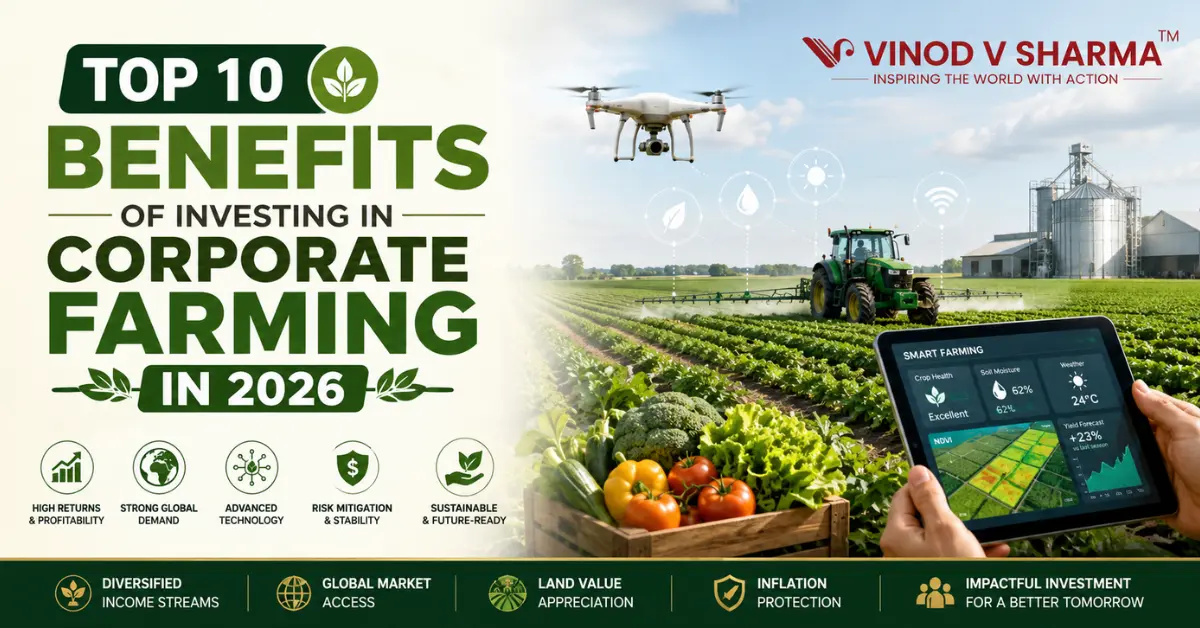
Corporate farming has emerged as one of the most promising investment opportunities in the global agricultural sector. As the world’s population continues to grow and food demand increases, traditional farming methods alone are no longer sufficient to meet future consumption needs. This has accelerated the adoption of large-scale, professionally managed farming operations that combine modern technology, sustainable practices, and efficient resource management.
In 2026, corporate farming is attracting the attention of investors, governments, agribusiness companies, and financial institutions because it offers the potential for consistent long-term returns while addressing critical global challenges such as food security, climate resilience, and sustainable agriculture.
Unlike conventional farming, corporate farming leverages advanced technologies such as precision agriculture, artificial intelligence (AI), drones, IoT sensors, satellite monitoring, automated irrigation systems, and data-driven farm management. These innovations help improve crop yields, reduce operational costs, optimize water and fertilizer usage, and minimize environmental impact.
Another major factor driving global interest is the increasing demand for high-quality agricultural products. Rising incomes, urbanization, changing dietary preferences, and expanding international trade have created significant opportunities for large-scale farming enterprises to supply domestic and global markets efficiently.
Governments across many countries are also encouraging agricultural modernization through supportive policies, infrastructure development, tax incentives, and public-private partnerships. At the same time, institutional investors, family offices, and private equity firms are increasingly viewing agriculture as a stable asset class that provides diversification and protection against inflation.
Corporate farming also aligns with Environmental, Social, and Governance (ESG) investment principles. Sustainable farming practices, responsible land management, renewable energy adoption, and efficient resource utilization make corporate farming an attractive option for investors seeking both financial returns and positive environmental impact.
As technology continues to transform agriculture and global food demand rises, corporate farming is evolving into a strategic investment sector with strong growth potential. For investors looking to participate in the future of agriculture, 2026 presents an ideal time to explore opportunities in this rapidly expanding industry.
What is Corporate Farming?
Corporate farming is a modern agricultural business model in which large-scale farming operations are owned, managed, or financed by companies, corporations, investment firms, cooperatives, or institutional investors rather than individual farmers. These enterprises operate with a commercial mindset, focusing on maximizing productivity, efficiency, sustainability, and profitability through advanced farming techniques and professional management.
Unlike traditional farming, where small landowners manage limited acreage using conventional methods, corporate farming integrates large tracts of agricultural land, modern machinery, precision agriculture, data analytics, artificial intelligence (AI), automation, and scientific crop management to optimize production and reduce operational costs.
The primary objective of corporate farming is not only to produce food but also to build a scalable and sustainable agricultural business that delivers consistent returns to stakeholders while meeting growing global food demand.
Key Characteristics of Corporate Farming
- Large-Scale Operations: Cultivates extensive agricultural land to achieve higher production and operational efficiency.
- Professional Management: Managed by experienced agricultural experts, business professionals, and technical specialists.
- Technology-Driven Agriculture: Uses AI, IoT sensors, drones, satellite imagery, GPS-guided machinery, precision irrigation, and farm management software.
- Efficient Resource Utilization: Optimizes the use of water, fertilizers, pesticides, labor, and energy to reduce waste and increase productivity.
- Market-Oriented Production: Focuses on growing crops and producing agricultural commodities based on market demand and profitability.
- Sustainable Farming Practices: Incorporates environmentally responsible methods such as water conservation, soil health management, renewable energy, and integrated pest management.
- Integrated Supply Chain: Often manages the entire value chain, including cultivation, processing, storage, packaging, logistics, and distribution.
How Corporate Farming Differs from Traditional Farming
| Farm Size | Small to Medium | Large-Scale |
| Ownership | Individual Farmers | Companies or Investment Groups |
| Management | Family-Based | Professional Management Teams |
| Technology | Basic or Conventional | AI, IoT, Drones, Automation |
| Investment | Limited Capital | Institutional and Private Investment |
| Productivity | Moderate | High and Optimized |
| Market Access | Local Markets | Domestic and International Markets |
| Risk Management | Limited | Diversified and Data-Driven |
| Profit Potential | Seasonal | Long-Term Commercial Growth |
Why Corporate Farming Matters
Corporate farming plays a crucial role in addressing some of the world’s biggest agricultural challenges. With the global population expected to continue growing, there is increasing pressure to produce more food using fewer natural resources. Large-scale farming operations help improve productivity, enhance food security, reduce post-harvest losses, and support sustainable agricultural development.
By combining innovation, efficient management, and responsible farming practices, corporate farming has become an attractive model for governments, agribusinesses, and investors seeking long-term growth while contributing to a more resilient and sustainable global food system.
Why 2026 is the Right Time to Invest in Corporate Farming
The global agricultural industry is undergoing a significant transformation, making 2026 one of the most attractive years to invest in corporate farming. Rising food demand, rapid technological innovation, government support, and increasing investor interest are creating a favorable environment for large-scale agricultural investments. As agriculture evolves into a technology-driven and commercially managed sector, corporate farming offers a unique opportunity to generate long-term wealth while contributing to global food security.
1. Growing Global Food Demand
The world’s population continues to increase, driving higher demand for food, animal feed, biofuels, and agricultural raw materials. Urbanization, rising incomes, and changing dietary habits are placing additional pressure on global food production. Corporate farming is well-positioned to meet this demand through efficient, large-scale operations and modern agricultural practices.
2. Rapid Adoption of Agricultural Technology
Technology is revolutionizing farming. Corporate farms are increasingly adopting Artificial Intelligence (AI), precision agriculture, drones, IoT sensors, satellite monitoring, automated irrigation, robotics, and data analytics to improve productivity and reduce costs. These innovations enable higher crop yields, better resource management, and improved profitability, making corporate farming a future-ready investment.
3. Increasing Government Support
Many governments are prioritizing agriculture to strengthen food security and rural development. Investors can benefit from supportive policies such as tax incentives, subsidies, infrastructure development, irrigation projects, crop insurance programs, and public-private partnerships that encourage agricultural modernization and sustainable farming.
4. Rising Demand for Sustainable Investments
Environmental, Social, and Governance (ESG) investing continues to gain momentum. Corporate farming aligns well with ESG principles by promoting responsible land management, efficient water use, renewable energy adoption, carbon reduction, and sustainable agricultural practices. This growing focus on sustainability is attracting institutional investors and impact-focused funds to the agricultural sector.
5. Strong Market Opportunities for Agricultural Exports
Global trade agreements and expanding international markets have increased demand for high-quality agricultural products. Corporate farms can produce consistent, export-grade crops while maintaining quality standards and supply chain efficiency. This opens new revenue opportunities and reduces dependence on local markets.
6. Higher Operational Efficiency
Unlike traditional farming, corporate farming benefits from economies of scale. Bulk purchasing of inputs, mechanized operations, professional management, and advanced logistics help reduce production costs while improving overall efficiency. This creates stronger profit margins and greater resilience against market fluctuations.
7. Agriculture as an Inflation Hedge
Agricultural assets, including farmland and crop production, have historically demonstrated resilience during periods of inflation. As food prices rise, agricultural investments often maintain or increase their value, providing investors with a natural hedge against inflation and economic uncertainty.
8. Growing Institutional Investor Interest
Private equity firms, family offices, sovereign wealth funds, and agribusiness companies are increasingly allocating capital to agriculture. Their growing participation reflects confidence in the sector’s long-term growth potential and helps accelerate innovation, infrastructure development, and commercialization within corporate farming.
9. Increasing Farmland Value
Productive agricultural land remains a limited resource while demand continues to grow. As urbanization expands and arable land becomes scarcer, farmland values have the potential to appreciate over time. Investors can benefit from both operational income and long-term capital appreciation.
10. Long-Term Wealth Creation
Corporate farming is not a short-term investment—it is a long-term growth opportunity. By combining agricultural production, technology, sustainable practices, and global market access, investors can build diversified portfolios that generate recurring income while benefiting from the long-term appreciation of agricultural assets.
The convergence of technology, sustainability, favorable government policies, and growing global food demand makes 2026 an ideal time to invest in corporate farming. Investors seeking stable, long-term returns, portfolio diversification, and exposure to one of the world’s most essential industries can find significant opportunities in this rapidly evolving sector. As agriculture becomes increasingly data-driven and commercially managed, corporate farming is poised to play a central role in the future of global food production and investment.
Top 10 Benefits of Investing in Corporate Farming
1. Higher Returns Compared to Traditional Agriculture
One of the primary reasons investors are turning to corporate farming in 2026 is its potential to generate higher and more consistent returns than traditional agriculture. While conventional farming often relies on manual labor, seasonal practices, and limited resources, corporate farming applies modern technology, professional management, and large-scale operations to maximize productivity and profitability.
By leveraging economies of scale, corporate farms can significantly reduce production costs while increasing crop yields. Advanced farming technologies such as precision agriculture, AI-powered analytics, IoT sensors, drone monitoring, automated irrigation, and GPS-guided machinery enable better decision-making and efficient use of resources. These innovations help optimize planting schedules, reduce water and fertilizer waste, improve crop health, and minimize losses from pests and diseases.
Another key advantage is diversification. Corporate farming businesses often cultivate multiple crops, integrate livestock, operate food processing facilities, or participate in value-added agricultural activities. This diversified business model reduces dependence on a single source of income and helps stabilize revenues even when market conditions fluctuate.
Professional management also contributes to stronger financial performance. Experienced agronomists, supply chain experts, financial managers, and marketing teams work together to improve operational efficiency, manage risks, and identify profitable market opportunities. Unlike many traditional farms, corporate farming enterprises typically have access to better financing, advanced infrastructure, and long-term contracts with buyers, ensuring more predictable cash flow.
Additionally, corporate farms can take advantage of domestic and international markets by producing export-quality agricultural products. Higher-quality produce often commands premium prices, further increasing profitability.
Why Corporate Farming Delivers Higher Returns
- Higher crop yields through advanced farming technologies and scientific cultivation methods.
- Lower production costs due to economies of scale and mechanization.
- Efficient resource management, reducing waste of water, fertilizers, and energy.
- Diversified income streams from crops, livestock, processing, and value-added products.
- Access to premium domestic and export markets with higher profit margins.
- Professional business management focused on maximizing operational efficiency and long-term profitability.
- Better risk management through crop diversification, insurance, and data-driven decision-making.
Investor Insight
While agriculture naturally involves risks such as weather conditions and commodity price fluctuations, corporate farming is better equipped to manage these challenges through technology, diversification, and professional oversight. As a result, investors can benefit from improved productivity, stronger operational performance, and the potential for attractive long-term returns compared to traditional farming methods.
For investors seeking sustainable wealth creation, corporate farming represents a modern agricultural business model that combines innovation, efficiency, and scalable growth—making it one of the most compelling investment opportunities in 2026.
2. Rising Global Demand for Food and Agricultural Products
One of the strongest drivers behind corporate farming investments in 2026 is the continuous rise in global demand for food and agricultural products. Population growth, urbanization, changing dietary habits, and expanding international trade are placing unprecedented pressure on the agricultural sector to produce more food while using resources more efficiently.
As millions of people move into urban areas and disposable incomes increase, consumer preferences are shifting toward higher-quality food, fresh produce, organic products, processed foods, and premium agricultural commodities. This growing demand creates significant opportunities for corporate farming enterprises that can produce large volumes of high-quality products consistently and efficiently.
Corporate farming is uniquely positioned to meet these evolving market needs through advanced technologies, scientific crop management, mechanization, and integrated supply chains. Large-scale operations enable businesses to maintain consistent quality, improve productivity, and fulfill long-term supply agreements with retailers, food processors, exporters, and international buyers.
In addition to food crops, demand is increasing for agricultural products used in industries such as pharmaceuticals, biofuels, textiles, cosmetics, animal feed, and wellness products. This broadens the revenue potential for corporate farming beyond traditional food production.
Factors Driving Global Food Demand
- Growing global population, increasing the need for reliable food production.
- Rapid urbanization, leading to higher consumption of packaged and processed foods.
- Rising incomes, encouraging greater demand for premium and nutritious food products.
- Changing dietary preferences, including increased consumption of fruits, vegetables, dairy, and protein-rich foods.
- Expansion of international trade, creating new export opportunities for agricultural producers.
- Increasing demand from non-food industries, including pharmaceuticals, cosmetics, biofuels, and animal nutrition.
Why Corporate Farming Benefits
Corporate farming offers several competitive advantages in meeting this growing demand:
- Produces large-scale, consistent, and high-quality agricultural output.
- Uses modern technology to improve productivity and reduce production costs.
- Maintains quality standards required by domestic and international buyers.
- Strengthens supply chain efficiency through integrated production, storage, processing, and distribution.
- Responds quickly to market demand by using data-driven planning and forecasting.
Investor Perspective
The demand for food is expected to remain strong regardless of economic cycles, making agriculture one of the world’s most resilient industries. As global consumption continues to rise and supply chains become more sophisticated, corporate farming is well-positioned to capitalize on long-term market trends.
For investors, this means exposure to a sector with sustained demand, multiple revenue opportunities, and strong long-term growth potential. By investing in corporate farming, individuals and institutions can participate in an industry that is essential to global economic development while building a portfolio designed for stability, scalability, and future growth.
3. Economies of Scale and Operational Efficiency
One of the greatest competitive advantages of corporate farming is its ability to achieve economies of scale. By operating across large areas of agricultural land, corporate farming businesses can significantly reduce the cost of production while improving overall efficiency. This allows them to produce more with fewer resources, resulting in higher profitability and stronger long-term returns for investors.
Unlike traditional farms, which often face challenges such as limited capital, manual labor, and fragmented operations, corporate farms invest in advanced machinery, modern infrastructure, and centralized management systems. These investments streamline farming activities, reduce operational expenses, and improve productivity across every stage of the agricultural value chain.
Large-scale operations also provide greater purchasing power. Corporate farms can buy seeds, fertilizers, equipment, and other agricultural inputs in bulk, often at discounted prices. At the same time, standardized farming practices help maintain consistent crop quality and reduce waste.
Automation further enhances operational efficiency. GPS-guided tractors, automated irrigation systems, drones, AI-powered crop monitoring, and precision farming technologies enable corporate farms to optimize planting, irrigation, fertilization, and harvesting. These technologies reduce labor dependency, minimize errors, and improve resource utilization, leading to lower costs and higher yields.
Corporate farming also benefits from integrated supply chain management. Many companies oversee the entire process—from cultivation and harvesting to storage, processing, packaging, and distribution. This integration reduces post-harvest losses, shortens delivery times, improves product quality, and increases overall profitability.
How Economies of Scale Benefit Corporate Farming
- Lower production costs through bulk purchasing of seeds, fertilizers, and equipment.
- Higher productivity with mechanized farming and advanced agricultural technologies.
- Reduced labor costs through automation and smart farming solutions.
- Efficient use of resources, including water, fertilizers, energy, and land.
- Improved crop quality through standardized farming practices and quality control.
- Integrated supply chain management that reduces waste and enhances profitability.
- Better negotiating power with suppliers, distributors, and export buyers due to large production volumes.
Why Operational Efficiency Matters for Investors
Operational efficiency directly impacts profitability. Farms that can produce more while spending less are better equipped to withstand fluctuations in commodity prices, labor shortages, and rising input costs. Efficient operations also improve cash flow, strengthen business resilience, and support long-term growth.
For investors, corporate farming offers a scalable business model where technology, professional management, and operational excellence work together to maximize returns. As agricultural businesses continue to modernize in 2026, companies that leverage economies of scale and efficient operations are expected to remain highly competitive and well-positioned for sustainable growth.
4. Adoption of Advanced Agricultural Technologies
Technology is transforming agriculture at an unprecedented pace, and corporate farming is leading this revolution. In 2026, the adoption of advanced agricultural technologies has become one of the biggest factors driving productivity, sustainability, and profitability in large-scale farming operations. By integrating cutting-edge innovations into daily farm management, corporate farms can make smarter decisions, reduce operational costs, and maximize crop yields.
Unlike traditional farming, which often relies on manual observation and conventional practices, corporate farming uses data-driven systems to monitor every stage of the production cycle. From soil preparation and planting to irrigation, pest control, and harvesting, technology enables farmers to optimize resources and improve overall efficiency.
Artificial Intelligence (AI) and machine learning analyze weather patterns, soil conditions, crop health, and historical data to recommend the best farming practices. Internet of Things (IoT) sensors continuously monitor moisture levels, temperature, humidity, and nutrient availability, allowing farmers to respond quickly to changing field conditions.
Drone technology and satellite imagery provide real-time aerial monitoring of crops, helping detect pest infestations, diseases, nutrient deficiencies, and irrigation issues before they become major problems. Automated irrigation systems ensure that crops receive the right amount of water at the right time, reducing water wastage while improving plant health.
Robotics and GPS-guided machinery are also becoming increasingly common in corporate farming. These technologies enable precise planting, fertilization, spraying, and harvesting, reducing labor costs and increasing operational accuracy. Farm management software further integrates production data, financial records, inventory, and logistics into a single platform, improving decision-making and business performance.
Key Technologies Driving Corporate Farming
- Artificial Intelligence (AI): Predicts crop performance, optimizes planting schedules, and supports data-driven decision-making.
- Internet of Things (IoT): Uses smart sensors to monitor soil moisture, temperature, humidity, and crop health in real time.
- Drones: Conduct aerial surveys, monitor crop growth, detect pests and diseases, and assess field conditions.
- Satellite Imaging: Tracks vegetation health, identifies stressed areas, and supports precision farming.
- Precision Agriculture: Applies water, fertilizers, and pesticides only where needed, reducing costs and environmental impact.
- Automated Irrigation Systems: Improve water efficiency and ensure consistent crop growth.
- GPS-Guided Machinery: Enhances accuracy in planting, fertilizing, spraying, and harvesting while minimizing waste.
- Farm Management Software: Integrates operational, financial, and supply chain data for better planning and performance.
Benefits of Technology Adoption
- Higher crop yields through precise and scientific farm management.
- Lower production costs by reducing waste and improving resource efficiency.
- Improved crop quality with continuous monitoring and timely interventions.
- Reduced labor dependency through automation and smart machinery.
- Better environmental sustainability by conserving water, fertilizers, and energy.
- Enhanced risk management through predictive analytics and early detection of crop issues.
- Greater profitability driven by increased productivity and operational efficiency.
Investor Perspective
The integration of advanced technologies is reshaping agriculture into a high-performance, innovation-driven industry. Corporate farms that embrace digital transformation are better equipped to adapt to climate challenges, optimize production, and respond to market demand.
For investors, technology adoption enhances scalability, improves operational resilience, and strengthens long-term profitability. As innovation continues to redefine modern agriculture, corporate farming stands out as a future-ready investment with significant growth potential in 2026 and beyond.
5. Diversified Revenue Streams
One of the key advantages of investing in corporate farming is the ability to generate income from multiple sources rather than relying on a single crop or seasonal harvest. Unlike traditional farming, where profitability often depends on one or two agricultural products, corporate farming adopts a diversified business model that creates multiple revenue streams, reducing financial risk and improving long-term stability.
In 2026, successful corporate farming enterprises are expanding beyond crop cultivation to include livestock, horticulture, food processing, storage, export operations, renewable energy, and value-added agricultural products. This diversification enables businesses to remain profitable even if one segment experiences lower prices or reduced demand.
For example, a corporate farm may grow grains, fruits, and vegetables while also producing dairy products, operating a food processing facility, or manufacturing organic fertilizers. Some companies lease farmland, offer contract farming services, or generate income from carbon credit programs and renewable energy projects such as solar-powered irrigation systems.
Value addition is another major source of profitability. Instead of selling raw agricultural commodities, corporate farms can process, package, brand, and market finished products that command higher prices in domestic and international markets. This approach increases profit margins while strengthening brand recognition and customer loyalty.
Common Revenue Streams in Corporate Farming
- Crop Production: Cultivation of cereals, fruits, vegetables, pulses, oilseeds, spices, and cash crops.
- Livestock Farming: Dairy, poultry, cattle, sheep, goat farming, and aquaculture.
- Food Processing: Converting raw produce into packaged, branded, or ready-to-consume products.
- Export of Agricultural Products: Supplying premium-quality produce to international markets.
- Contract Farming: Producing crops for food processors, retailers, or exporters under long-term agreements.
- Value-Added Products: Organic foods, essential oils, herbal products, processed foods, and specialty agricultural goods.
- Renewable Energy Projects: Solar-powered farms, biogas production, and biomass energy generation.
- Agritourism and Educational Programs: Farm visits, agricultural training, eco-tourism, and experiential learning initiatives.
- Carbon Credits and Sustainability Programs: Earning additional income through environmentally responsible farming practices.
Benefits of Revenue Diversification
- Reduces dependence on a single crop or commodity.
- Minimizes the impact of market price fluctuations.
- Creates stable and recurring income throughout the year.
- Improves business resilience during adverse weather or economic conditions.
- Increases overall profitability through value-added products and services.
- Enhances long-term financial sustainability and investor confidence.
Investor Perspective
Diversified revenue streams make corporate farming a more resilient and attractive investment compared to traditional agricultural models. By generating income from multiple business activities, corporate farming reduces operational risk while creating opportunities for sustained growth and higher returns.
For investors seeking a balanced portfolio, corporate farming offers the advantage of combining agricultural production with processing, exports, renewable energy, and other complementary businesses. This diversified approach not only strengthens financial performance but also positions corporate farming as a future-ready investment capable of adapting to changing market conditions and consumer demand.
6. Government Support and Agricultural Incentives
Government policies and agricultural incentives play a crucial role in the growth and profitability of corporate farming. In 2026, many countries are prioritizing agriculture as a strategic sector to strengthen food security, promote rural development, increase exports, and encourage sustainable farming practices. As a result, governments are introducing supportive policies that create a favorable environment for large-scale agricultural investments.
Corporate farming businesses often benefit from incentives designed to modernize agriculture and improve productivity. These may include tax benefits, subsidized loans, grants for farm infrastructure, irrigation support, crop insurance programs, technology adoption incentives, and investments in rural infrastructure such as roads, storage facilities, and logistics networks.
Many governments are also encouraging the adoption of precision agriculture, renewable energy, water conservation systems, and climate-smart farming through financial assistance and public-private partnerships. These initiatives help reduce operational costs while promoting environmentally responsible agricultural practices.
In addition, export-oriented agricultural policies and trade agreements are opening new international markets for agricultural producers. Support for quality certification, food safety compliance, and export infrastructure enables corporate farms to compete more effectively in global markets and generate higher-value revenue.
Common Government Support for Corporate Farming
- Tax incentives for agricultural businesses and agribusiness investments.
- Subsidized agricultural loans with competitive interest rates.
- Grants and financial assistance for irrigation, mechanization, and farm infrastructure.
- Crop insurance programs that protect against natural disasters and production losses.
- Research and development support for innovative farming technologies.
- Training and extension services to improve agricultural skills and productivity.
- Export promotion programs that help farmers access international markets.
- Public-private partnerships (PPPs) for agricultural infrastructure and value chain development.
- Renewable energy incentives for solar-powered irrigation, biomass projects, and sustainable farming.
Benefits for Investors
Government support reduces many of the financial and operational risks associated with agriculture. Incentives lower capital investment requirements, improve access to financing, encourage technology adoption, and strengthen long-term business sustainability. Infrastructure improvements also enhance supply chain efficiency, reduce post-harvest losses, and improve market access.
Investor Perspective
Supportive government policies create a more stable investment environment for corporate farming. While specific incentives vary by country and region, the global trend toward agricultural modernization and food security continues to drive public investment in the sector.
For investors, this means greater opportunities to participate in an industry backed by policy support, infrastructure development, and long-term economic priorities. When combined with technological innovation and growing food demand, government incentives make corporate farming an increasingly attractive investment opportunity in 2026 and beyond.
7. Sustainable and ESG-Focused Investment Opportunities
Sustainability has become a major priority for investors, businesses, and governments worldwide. In 2026, Environmental, Social, and Governance (ESG) principles are playing an increasingly important role in investment decisions, and corporate farming has emerged as a sector that aligns well with these long-term sustainability goals. By adopting environmentally responsible practices and promoting social and economic development, corporate farming offers investors the opportunity to generate financial returns while creating a positive impact.
Modern corporate farming focuses on producing more food with fewer natural resources. Through precision agriculture, efficient irrigation systems, renewable energy, and responsible land management, large-scale farming operations can reduce water consumption, minimize chemical usage, lower greenhouse gas emissions, and improve soil health. These practices not only protect the environment but also enhance long-term farm productivity and resilience.
Corporate farming also contributes to social sustainability by creating employment opportunities, supporting rural communities, improving farmer training, and encouraging responsible labor practices. Many companies work closely with local farmers through contract farming, technical assistance, and knowledge-sharing programs, helping improve agricultural productivity and rural livelihoods.
Strong governance is another key component of ESG-focused corporate farming. Professionally managed agricultural enterprises typically implement transparent financial reporting, regulatory compliance, ethical sourcing, risk management, and sustainable supply chain practices. These governance standards increase investor confidence and strengthen long-term business performance.
How Corporate Farming Supports ESG Goals
Environmental (E)
- Efficient water management through smart irrigation systems.
- Reduced use of fertilizers and pesticides with precision agriculture.
- Improved soil health through sustainable cultivation practices.
- Lower carbon emissions through renewable energy and efficient farm operations.
- Biodiversity conservation and responsible land management.
Social (S)
- Job creation and rural economic development.
- Fair labor practices and safe working conditions.
- Farmer education and agricultural training programs.
- Community engagement and local supplier partnerships.
- Improved food security through increased agricultural production.
Governance (G)
- Transparent business operations and financial reporting.
- Ethical sourcing and responsible supply chain management.
- Compliance with environmental and agricultural regulations.
- Strong corporate governance and professional management.
- Effective risk management and long-term strategic planning.
Benefits of ESG-Focused Corporate Farming
- Attracts institutional investors seeking sustainable investment opportunities.
- Enhances long-term business resilience through responsible resource management.
- Improves brand reputation among consumers and business partners.
- Supports regulatory compliance and reduces environmental risks.
- Creates lasting value for investors, communities, and the environment.
- Strengthens access to green financing and sustainability-linked investment funds.
Investor Perspective
Investing in corporate farming is no longer just about financial returns—it is also about supporting a more sustainable and resilient agricultural future. As ESG investing continues to grow, companies that prioritize environmental stewardship, social responsibility, and strong governance are increasingly attracting global capital.
For investors looking to build a future-focused portfolio, corporate farming offers a unique combination of profitability, sustainability, and long-term growth. By investing in ESG-driven agricultural businesses, investors can participate in an industry that contributes to global food security while delivering meaningful economic, environmental, and social value.
8. Strong Export Potential and Global Market Access
One of the most attractive advantages of corporate farming is its ability to access international markets and capitalize on the growing global demand for agricultural products. In 2026, expanding trade agreements, improved logistics, and increasing consumer demand for high-quality food have created significant export opportunities for professionally managed agricultural enterprises.
Unlike small-scale farms that often face limitations in production capacity and quality consistency, corporate farming operates on a large scale with standardized cultivation practices, advanced quality control systems, and efficient supply chain management. This enables corporate farms to meet the stringent quality, safety, and traceability requirements of international buyers, making them competitive in global markets.
Many countries rely on agricultural imports to meet domestic demand for fruits, vegetables, grains, spices, oilseeds, dairy products, and processed foods. As global populations grow and consumer preferences evolve, demand for premium, organic, and sustainably produced agricultural products continues to rise. Corporate farming businesses are well-positioned to serve these expanding markets while building long-term relationships with importers, retailers, food manufacturers, and distributors.
Access to international markets also helps reduce dependence on domestic demand. By exporting products to multiple countries, corporate farms can diversify their customer base, reduce market risks, and generate more stable revenue throughout the year.
Factors Driving Export Growth
- Rising global demand for safe, high-quality agricultural products.
- Expanding international trade agreements that improve market access.
- Increasing demand for organic and sustainably produced food.
- Growing food processing and manufacturing industries worldwide.
- Improved cold chain logistics, storage, and transportation infrastructure.
- Higher demand for premium agricultural commodities in developed and emerging markets.
How Corporate Farming Supports Global Market Access
- Produces consistent, export-quality products that meet international standards.
- Implements quality assurance and traceability systems required by global buyers.
- Uses modern storage, packaging, and logistics to preserve product quality.
- Builds long-term supply contracts with retailers, wholesalers, and food processors.
- Diversifies sales across multiple international markets, reducing dependence on a single region.
Benefits for Investors
Strong export potential provides corporate farming businesses with access to larger and more profitable markets. International buyers often pay premium prices for high-quality products that meet food safety and sustainability standards, helping improve profit margins and long-term revenue growth.
Export diversification also reduces exposure to domestic market fluctuations, making the business more resilient during periods of changing local demand or pricing pressures.
Investor Perspective
As global food trade continues to expand, corporate farming is becoming an increasingly attractive investment for those seeking long-term growth opportunities. Companies with strong export capabilities, efficient supply chains, and internationally recognized quality standards are better positioned to compete in the global marketplace.
For investors, this means access to a business model that combines growing international demand, diversified revenue streams, and scalable operations. With global market access becoming a key driver of agricultural profitability, corporate farming offers significant potential for sustainable growth and long-term value creation in 2026 and beyond.
9. Long-Term Land Value Appreciation
Agricultural land has long been recognized as one of the world’s most valuable and resilient real assets. As the global population continues to grow and the availability of productive farmland becomes increasingly limited, the long-term value of agricultural land is expected to appreciate steadily. In 2026, this makes corporate farming an attractive investment not only for its operational income but also for the potential capital appreciation of the land itself.
Unlike many traditional investments that rely solely on market performance, corporate farming offers a dual return opportunity. Investors can benefit from recurring income generated through agricultural operations while also gaining from the increasing value of productive farmland over time. This combination of cash flow and asset appreciation makes corporate farming a compelling long-term investment strategy.
Several factors contribute to rising farmland values. Rapid urbanization, industrial expansion, infrastructure development, and climate-related challenges are reducing the availability of high-quality agricultural land. At the same time, demand for food production continues to increase, making fertile farmland an increasingly scarce and valuable resource.
Corporate farming companies further enhance land value through continuous investment in infrastructure and sustainable land management. Modern irrigation systems, drainage networks, soil improvement programs, renewable energy installations, storage facilities, and precision farming technologies improve both productivity and the long-term worth of the property.
Factors Driving Land Value Appreciation
- Limited supply of productive farmland due to urbanization and industrial development.
- Growing global demand for food, increasing the strategic importance of agricultural land.
- Investments in farm infrastructure, including irrigation, storage, roads, and mechanization.
- Improved soil health and land productivity through sustainable farming practices.
- Advancements in agricultural technology that maximize the earning potential of farmland.
- Increasing interest from institutional investors seeking stable real assets with long-term growth potential.
Benefits of Land Appreciation for Investors
- Long-term capital growth as farmland values increase over time.
- Dual return potential through operational income and asset appreciation.
- Protection against inflation, as real assets often retain or increase their value during inflationary periods.
- Portfolio diversification by adding tangible assets with historically lower correlation to traditional financial markets.
- Enhanced financial security through ownership of productive, income-generating land.
Why Corporate Farming Maximizes Land Value
Corporate farming businesses actively invest in improving the productivity and sustainability of their agricultural assets. By implementing advanced irrigation systems, precision agriculture, soil conservation measures, and modern infrastructure, they increase both annual farm output and the intrinsic value of the land. Well-managed farmland often commands higher market prices due to its proven productivity, efficient operations, and strong long-term earning potential.
Investor Perspective
Farmland is increasingly viewed as a strategic investment asset because of its scarcity, essential role in food production, and ability to generate long-term value. While short-term market conditions may influence agricultural income, productive land has historically demonstrated resilience and steady appreciation over extended periods.
For investors seeking stable wealth creation, corporate farming offers the unique advantage of combining recurring agricultural revenue with the long-term appreciation of high-quality farmland. As demand for food continues to rise and arable land becomes more limited, land ownership within professionally managed corporate farming operations is expected to remain a valuable component of a diversified investment portfolio well beyond 2026.
10. Portfolio Diversification and Inflation Protection
A well-diversified investment portfolio is essential for managing risk and achieving long-term financial growth. In 2026, corporate farming has become an increasingly attractive asset class because it offers investors both portfolio diversification and protection against inflation. Unlike stocks, bonds, or other traditional financial assets, agricultural investments are backed by tangible resources such as farmland, crops, infrastructure, and agricultural production, making them more resilient during periods of economic uncertainty.
Corporate farming often has a lower correlation with traditional financial markets. This means that when equity or bond markets experience volatility, agricultural investments may perform differently, helping to reduce overall portfolio risk. Since food is a basic human necessity, demand for agricultural products tends to remain relatively stable regardless of economic conditions, providing a more defensive investment profile.
Inflation is another important consideration for investors. As the cost of goods and services rises, food prices and agricultural commodity prices often increase as well. Corporate farming businesses can benefit from these trends through higher revenues from crop production, livestock, and value-added agricultural products. At the same time, farmland itself has historically demonstrated the potential to appreciate over the long term, offering an additional layer of protection against inflation.
Corporate farming also generates multiple sources of value through agricultural operations, land appreciation, processing activities, and export opportunities. This combination of recurring income and tangible asset ownership makes it a compelling option for investors seeking both stability and long-term growth.
How Corporate Farming Diversifies an Investment Portfolio
- Low correlation with traditional financial markets, helping reduce overall portfolio volatility.
- Exposure to the agricultural sector, an essential industry with consistent long-term demand.
- Ownership of tangible assets, including productive farmland and agricultural infrastructure.
- Multiple revenue sources, including crop production, livestock, food processing, exports, and value-added products.
- Balanced risk profile through diversified agricultural operations and markets.
How Corporate Farming Helps Protect Against Inflation
- Food demand remains steady, even during economic downturns.
- Agricultural commodity prices often rise alongside inflation, supporting revenue growth.
- Farmland values have the potential to appreciate over the long term as productive land becomes increasingly scarce.
- Real assets tend to retain value, providing greater resilience during periods of rising prices.
- Long-term supply and demand fundamentals support sustained growth in the agricultural sector.
Key Benefits for Investors
- Improves portfolio diversification by adding a non-traditional asset class.
- Reduces investment risk through exposure to a resilient and essential industry.
- Provides potential inflation protection through agricultural income and land appreciation.
- Offers long-term capital growth supported by increasing global food demand.
- Creates recurring income opportunities from diversified farming operations.
Investor Perspective
Corporate farming offers a unique combination of income generation, capital appreciation, and risk management. By adding agricultural investments to a diversified portfolio, investors gain exposure to a sector that is driven by fundamental global needs rather than short-term market sentiment.
As inflation, economic uncertainty, and market volatility continue to influence investment decisions, corporate farming stands out as a resilient long-term asset. For investors seeking stability, sustainable growth, and protection against inflation, corporate farming represents a strategic addition to a well-balanced investment portfolio in 2026 and beyond.
Key Technologies Driving Corporate Farming
Technology is revolutionizing the agricultural industry, transforming traditional farming into a highly efficient, data-driven, and sustainable business. In 2026, corporate farming relies on advanced technologies to improve productivity, optimize resource utilization, reduce operational costs, and increase profitability. These innovations enable large-scale agricultural enterprises to make informed decisions, manage risks effectively, and meet the growing global demand for food.
Below are the key technologies driving the future of corporate farming.
1. Artificial Intelligence (AI) and Machine Learning
Artificial Intelligence (AI) is helping farmers make smarter decisions by analyzing large volumes of agricultural data. AI-powered systems can predict crop yields, identify pest outbreaks, recommend optimal planting schedules, and forecast weather patterns. Machine learning continuously improves these predictions, enabling more accurate farm management over time.
Benefits:
- Predicts crop performance and yields.
- Detects diseases and pests early.
- Optimizes planting and harvesting schedules.
- Supports data-driven decision-making.
2. Precision Agriculture
Precision agriculture uses GPS technology, sensors, and data analytics to apply water, fertilizers, and pesticides only where they are needed. This targeted approach improves efficiency while reducing waste and environmental impact.
Benefits:
- Increases crop productivity.
- Reduces fertilizer and pesticide costs.
- Improves soil health.
- Enhances resource efficiency.
3. Internet of Things (IoT)
IoT devices connect farms through smart sensors that continuously monitor soil moisture, temperature, humidity, nutrient levels, and weather conditions. Farmers receive real-time information that helps optimize irrigation, fertilization, and crop management.
Benefits:
- Real-time field monitoring.
- Improved water management.
- Early detection of crop stress.
- Better operational control.
4. Drone Technology
Agricultural drones provide aerial views of farmland, allowing farmers to monitor crop health, identify pest infestations, assess irrigation efficiency, and evaluate overall field conditions. Drones also assist with spraying fertilizers and crop protection products in large farming operations.
Benefits:
- Faster crop inspections.
- Reduced labor costs.
- Early disease detection.
- Improved field mapping.
5. Satellite Imaging and Remote Sensing
Satellite imagery enables farmers to monitor vegetation health, soil conditions, moisture levels, and crop growth over large agricultural areas. Remote sensing technologies help identify potential problems before they affect production.
Benefits:
- Monitors crop growth remotely.
- Tracks vegetation health.
- Supports precision farming.
- Improves yield forecasting.
6. Smart Irrigation Systems
Modern irrigation systems use sensors and weather data to deliver the right amount of water at the right time. Automated irrigation reduces water consumption while maintaining optimal growing conditions.
Benefits:
- Conserves water.
- Reduces irrigation costs.
- Improves crop quality.
- Supports sustainable farming.
7. Robotics and Farm Automation
Automation is becoming increasingly common in corporate farming. Autonomous tractors, robotic harvesters, automated seeders, and mechanical weed control systems reduce labor requirements while improving operational accuracy.
Benefits:
- Increases efficiency.
- Reduces labor dependency.
- Improves harvesting accuracy.
- Lowers operational costs.
8. GPS-Guided Farm Equipment
GPS-enabled machinery allows tractors and harvesters to operate with high precision. This reduces overlap during planting, spraying, and harvesting while minimizing input waste.
Benefits:
- Precise field operations.
- Lower fuel consumption.
- Reduced input waste.
- Higher productivity.
9. Farm Management Software
Digital farm management platforms integrate production planning, financial management, inventory control, workforce management, equipment maintenance, and supply chain operations into one centralized system.
Benefits:
- Better financial tracking.
- Improved operational planning.
- Enhanced inventory management.
- Data-driven business decisions.
10. Blockchain for Supply Chain Transparency
Blockchain technology improves transparency by recording every stage of the agricultural supply chain, from farm production to final delivery. This enhances traceability, food safety, and consumer trust.
Benefits:
- Improved product traceability.
- Enhanced food safety.
- Greater transparency.
- Reduced fraud in supply chains.
11. Renewable Energy Solutions
Many corporate farms are adopting renewable energy sources such as solar power, wind energy, and biogas systems to reduce operating costs and improve sustainability. Renewable energy also supports irrigation systems, cold storage facilities, and processing units.
Benefits:
- Lower energy costs.
- Reduced carbon emissions.
- Improved energy independence.
- Greater environmental sustainability.
12. Big Data and Predictive Analytics
Corporate farms collect vast amounts of information from sensors, machinery, satellites, weather stations, and market trends. Big data analytics converts this information into actionable insights that improve productivity and profitability.
Benefits:
- Better production forecasting.
- Improved risk management.
- Optimized resource allocation.
- Higher long-term profitability.
Why Technology Matters in Corporate Farming
The integration of advanced technologies allows corporate farming businesses to:
- Increase agricultural productivity and crop yields.
- Reduce production costs through automation and precision farming.
- Improve water, fertilizer, and energy efficiency.
- Minimize environmental impact through sustainable practices.
- Enhance food quality, traceability, and supply chain management.
- Strengthen resilience against climate change and market fluctuations.
- Generate higher profitability and long-term value for investors.
Technology is at the heart of modern corporate farming. From AI-powered analytics and IoT sensors to drones, robotics, blockchain, and renewable energy, these innovations are transforming agriculture into a smarter, more efficient, and highly profitable industry.
As global food demand continues to rise and sustainability becomes increasingly important, corporate farming businesses that embrace advanced technologies will be better positioned to improve productivity, reduce risks, and deliver long-term returns. For investors, technology-driven agriculture represents one of the strongest growth opportunities in the agricultural sector in 2026 and beyond.
Potential Risks and How to Mitigate Them
Like any investment, corporate farming comes with certain risks. While the sector offers significant opportunities for long-term growth, investors should understand the potential challenges before committing capital. The good news is that many of these risks can be effectively managed through technology, diversification, professional management, insurance, and strategic planning.
By identifying risks early and implementing appropriate mitigation strategies, corporate farming businesses can improve operational resilience and deliver more stable returns over the long term.
1. Climate Change and Extreme Weather
Agriculture is naturally exposed to changing weather conditions. Droughts, floods, storms, heatwaves, and unpredictable rainfall can affect crop yields and farm profitability.
Risk
- Reduced crop production.
- Damage to farmland and infrastructure.
- Increased irrigation and recovery costs.
Mitigation
- Adopt climate-smart farming practices.
- Install efficient irrigation and water conservation systems.
- Diversify crops suited to different climatic conditions.
- Use weather forecasting and AI-based predictive analytics.
- Purchase comprehensive crop insurance.
2. Commodity Price Volatility
Agricultural commodity prices fluctuate due to global supply and demand, geopolitical events, currency movements, and market conditions.
Risk
- Lower revenues during price declines.
- Reduced profit margins.
Mitigation
- Diversify crop portfolios.
- Secure long-term supply contracts.
- Develop value-added agricultural products.
- Expand into export markets.
- Monitor market trends using data analytics.
3. Pest and Disease Outbreaks
Crop diseases, insects, and livestock diseases can significantly reduce production if not detected early.
Risk
- Crop losses.
- Increased treatment costs.
- Reduced product quality.
Mitigation
- Implement integrated pest management (IPM).
- Use AI-based crop monitoring and drones.
- Conduct regular field inspections.
- Rotate crops to improve soil health.
- Invest in disease-resistant crop varieties.
4. Water Scarcity
Water shortages are becoming a major concern in many agricultural regions due to climate change and increasing demand.
Risk
- Lower crop yields.
- Increased irrigation expenses.
- Production delays.
Mitigation
- Install drip and smart irrigation systems.
- Harvest and store rainwater.
- Monitor soil moisture using IoT sensors.
- Select drought-resistant crops.
- Improve water-use efficiency.
5. Regulatory and Policy Changes
Government regulations regarding land use, environmental protection, exports, labor, and taxation may change over time.
Risk
- Increased compliance costs.
- Business disruptions.
- Delays in project approvals.
Mitigation
- Stay informed about policy developments.
- Maintain strong legal and regulatory compliance.
- Work with experienced legal and agricultural advisors.
- Diversify operations across regions where appropriate.
6. Labor Shortages
Agriculture often faces shortages of skilled labor, particularly during planting and harvesting seasons.
Risk
- Higher labor costs.
- Operational delays.
- Lower productivity.
Mitigation
- Invest in automation and mechanization.
- Use GPS-guided equipment and robotic systems.
- Train and retain skilled employees.
- Improve workforce planning.
7. Supply Chain Disruptions
Transportation delays, logistics issues, fuel price increases, and global trade disruptions can impact agricultural businesses.
Risk
- Delayed product deliveries.
- Higher transportation costs.
- Inventory losses.
Mitigation
- Develop multiple distribution channels.
- Invest in storage and cold chain facilities.
- Build strong relationships with logistics providers.
- Diversify domestic and international markets.
8. Financial and Investment Risks
Large-scale farming requires significant capital for land, machinery, infrastructure, and technology.
Risk
- High upfront investment.
- Cash flow challenges.
- Financing constraints.
Mitigation
- Maintain a balanced capital structure.
- Prepare long-term financial plans.
- Diversify funding sources.
- Monitor cash flow regularly.
- Invest in projects with clear return-on-investment (ROI) potential.
9. Technology Implementation Challenges
While technology improves efficiency, improper implementation or lack of technical expertise can reduce its effectiveness.
Risk
- Increased operational costs.
- System failures.
- Employee training challenges.
Mitigation
- Introduce technology in phases.
- Partner with reputable technology providers.
- Train employees regularly.
- Maintain backup systems and technical support.
10. Market and Consumer Preference Changes
Consumer demand continues to evolve, with increasing interest in organic, sustainable, and premium agricultural products.
Risk
- Reduced demand for certain products.
- Lower market competitiveness.
Mitigation
- Conduct regular market research.
- Diversify product offerings.
- Invest in branding and value-added products.
- Monitor global consumer trends.
- Adapt production based on market demand.
Risk Management Best Practices
Successful corporate farming businesses implement comprehensive risk management strategies, including:
- Diversifying crops, markets, and revenue streams.
- Investing in precision agriculture and smart farming technologies.
- Maintaining adequate insurance coverage.
- Building efficient supply chains.
- Monitoring financial performance regularly.
- Following sustainable farming practices.
- Establishing strong governance and compliance systems.
- Continuously evaluating market trends and emerging risks.
Investor Perspective
Every investment involves risk, but corporate farming offers multiple tools to manage uncertainty effectively. Advances in agricultural technology, improved risk management practices, diversified business models, and professional management have significantly enhanced the resilience of modern farming operations.
For investors, the key is to evaluate the quality of the management team, technology adoption, financial strength, sustainability practices, and market positioning before investing. A well-managed corporate farming enterprise with strong risk mitigation strategies is better equipped to navigate market fluctuations, climate challenges, and operational uncertainties.
While corporate farming faces challenges such as climate risks, market volatility, regulatory changes, and operational complexities, these risks can be substantially reduced through careful planning, innovation, and professional management. Investors who choose well-managed, technology-driven, and diversified corporate farming businesses are likely to benefit from stronger resilience, sustainable growth, and long-term value creation.
Understanding both the opportunities and the risks allows investors to make informed decisions and build confidence in one of the world’s fastest-evolving agricultural investment sectors.
How to Evaluate a Corporate Farming Investment
Investing in corporate farming can provide attractive long-term returns, but choosing the right opportunity requires careful evaluation. Not all farming projects are equally profitable or sustainable. Investors should assess financial performance, operational efficiency, land quality, management expertise, technology adoption, and market potential before making an investment decision.
A thorough due diligence process helps minimize risk and increases the likelihood of achieving stable, long-term returns.
1. Evaluate the Quality of Agricultural Land
Farmland is the foundation of any corporate farming business. The productivity and long-term value of the investment depend heavily on the quality of the land.
Key Factors to Consider:
- Soil fertility and nutrient levels.
- Availability of reliable water sources.
- Climate suitability for planned crops.
- Land ownership and legal documentation.
- Accessibility to roads, storage, and transportation.
2. Assess the Management Team
The experience and expertise of the management team play a critical role in the success of a corporate farming business.
Look for:
- Experienced agricultural professionals.
- Strong financial and operational management.
- Proven track record in large-scale farming.
- Transparent governance and reporting.
- Clear long-term business strategy.
3. Review the Business Model
Understand how the company generates revenue and whether its operations are diversified.
Questions to Ask:
- Which crops or livestock does the company produce?
- Are there multiple revenue streams?
- Does the company process or export agricultural products?
- Are long-term supply agreements in place?
- How diversified are the company’s markets?
4. Analyze Financial Performance
Financial health is one of the most important indicators of investment quality.
Review:
- Revenue growth.
- Profit margins.
- Operating expenses.
- Cash flow stability.
- Debt levels.
- Return on investment (ROI).
- Long-term growth projections.
Companies with strong financial discipline are generally better positioned for sustainable growth.
5. Examine Technology Adoption
Technology significantly improves efficiency and profitability in modern agriculture.
Look for the use of:
- Artificial Intelligence (AI).
- Precision agriculture.
- Drone monitoring.
- IoT sensors.
- Automated irrigation systems.
- GPS-guided machinery.
- Farm management software.
Technology-driven farms typically achieve higher productivity and better resource utilization.
6. Evaluate Sustainability Practices
Sustainable farming helps protect natural resources while improving long-term profitability.
Assess whether the company:
- Uses water-efficient irrigation systems.
- Practices soil conservation.
- Reduces chemical inputs through precision farming.
- Utilizes renewable energy.
- Follows responsible waste management.
- Meets ESG (Environmental, Social, and Governance) standards.
Sustainability can also improve access to premium markets and ESG-focused investors.
7. Assess Market Demand and Sales Strategy
Even highly productive farms require strong market access to generate consistent profits.
Evaluate:
- Domestic and export market opportunities.
- Customer diversification.
- Supply agreements with retailers and processors.
- Branding and value-added products.
- Demand trends for the company’s agricultural products.
8. Understand Risk Management Strategies
Every agricultural investment involves risks. Evaluate how the company manages them.
Look for:
- Crop diversification.
- Crop insurance coverage.
- Climate adaptation strategies.
- Financial reserves.
- Supply chain resilience.
- Regulatory compliance.
- Disaster recovery planning.
Strong risk management improves business stability.
9. Review Infrastructure and Operational Efficiency
Modern infrastructure increases productivity and reduces operational costs.
Important assets include:
- Irrigation systems.
- Warehouses and cold storage.
- Food processing facilities.
- Transportation and logistics.
- Farm machinery and equipment.
- Renewable energy installations.
Well-developed infrastructure often contributes to higher profitability.
10. Consider Long-Term Growth Potential
Corporate farming should be evaluated as a long-term investment rather than a short-term opportunity.
Growth indicators include:
- Expansion plans.
- Land acquisition strategy.
- Technology investments.
- Export opportunities.
- New product development.
- Partnerships and strategic alliances.
- Future demand for agricultural products.
Companies with scalable business models are better positioned for long-term success.
Corporate Farming Investment Evaluation Checklist
| Land Quality | Soil, water availability, location, legal ownership |
| Management | Experience, transparency, governance |
| Financial Performance | Revenue, profitability, cash flow, debt |
| Business Model | Diversified income and market strategy |
| Technology | AI, IoT, automation, precision farming |
| Sustainability | ESG practices, water conservation, renewable energy |
| Market Access | Domestic and export opportunities |
| Risk Management | Insurance, diversification, climate resilience |
| Infrastructure | Irrigation, storage, processing, logistics |
| Growth Potential | Expansion strategy and long-term scalability |
Questions Every Investor Should Ask
Before investing, consider asking:
- Is the farmland legally owned or leased?
- What crops or products generate the majority of revenue?
- What technologies are being used to improve productivity?
- How does the company manage climate and operational risks?
- What are the expected returns and investment timeline?
- Does the business have long-term customer or export contracts?
- What sustainability and ESG initiatives are in place?
- How experienced is the management team?
- What is the company’s growth strategy over the next five to ten years?
A successful corporate farming investment goes beyond purchasing agricultural land—it involves investing in a professionally managed, technology-driven, and financially sound business. By carefully evaluating land quality, management expertise, financial performance, technology adoption, sustainability practices, and market opportunities, investors can make informed decisions and reduce investment risk.
As agriculture continues to modernize in 2026, companies that combine innovation, operational excellence, and sustainable practices are likely to deliver stronger long-term returns. A disciplined evaluation process ensures that investors select opportunities with the greatest potential for profitability, resilience, and long-term value creation.
Who Should Invest in Corporate Farming?
Corporate farming is an attractive investment opportunity for a wide range of investors seeking long-term growth, portfolio diversification, and exposure to one of the world’s most essential industries. As agriculture becomes increasingly technology-driven and commercially managed, corporate farming offers opportunities for individuals, institutions, and businesses to benefit from the growing global demand for food and sustainable agricultural products.
Whether you’re looking for stable income, long-term capital appreciation, or ESG-focused investments, corporate farming can be a valuable addition to your investment portfolio.
1. Individual Investors
Individual investors seeking long-term wealth creation can benefit from corporate farming as part of a diversified investment strategy. Agricultural investments often provide exposure to tangible assets while offering the potential for recurring income and long-term capital growth.
Why It Fits
- Diversifies investment portfolios.
- Provides exposure to a resilient industry.
- Offers long-term appreciation potential.
- Helps reduce reliance on traditional financial markets.
2. High-Net-Worth Individuals (HNWIs)
High-net-worth individuals often look for alternative investments that preserve wealth while generating consistent returns. Corporate farming combines productive land ownership, professional management, and scalable operations, making it an attractive option for long-term capital preservation and growth.
Benefits
- Access to large-scale agricultural opportunities.
- Potential for stable cash flow.
- Long-term asset appreciation.
- Inflation protection through real assets.
3. Family Offices
Family offices managing multi-generational wealth frequently allocate capital to real assets that offer stability and long-term value. Corporate farming aligns well with these objectives by combining operational income with the appreciation of agricultural land.
Why Family Offices Invest
- Wealth preservation.
- Portfolio diversification.
- Long-term investment horizon.
- ESG and sustainability alignment.
4. Institutional Investors
Pension funds, insurance companies, sovereign wealth funds, and endowments increasingly view agriculture as an alternative asset class capable of generating stable returns over extended periods.
Advantages
- Large-scale investment opportunities.
- Professional governance.
- Predictable long-term demand.
- Lower correlation with traditional asset classes.
5. Private Equity and Venture Capital Firms
Private equity firms often invest in corporate farming businesses that demonstrate strong growth potential through technology adoption, operational improvements, and market expansion.
Investment Focus
- Farm technology.
- Agribusiness expansion.
- Food processing.
- Supply chain optimization.
- Export-oriented businesses.
6. Agribusiness Companies
Companies involved in food production, processing, logistics, and agricultural inputs may invest in corporate farming to strengthen supply chains and secure access to high-quality raw materials.
Benefits
- Greater supply chain control.
- Improved product quality.
- Better cost management.
- Increased operational efficiency.
7. ESG and Impact Investors
Investors who prioritize environmental and social impact are increasingly attracted to corporate farming businesses that implement sustainable agricultural practices and responsible resource management.
Why ESG Investors Participate
- Supports sustainable agriculture.
- Encourages responsible land management.
- Promotes rural employment.
- Contributes to food security.
- Aligns with long-term sustainability goals.
8. Investors Seeking Inflation Protection
Corporate farming appeals to investors looking for assets that can help preserve purchasing power during inflationary periods. Agricultural land and food production have historically shown resilience when prices rise.
Key Benefits
- Tangible asset ownership.
- Potential farmland appreciation.
- Exposure to rising food demand.
- Long-term wealth preservation.
9. Long-Term Retirement Investors
Individuals planning for retirement may consider corporate farming as part of a diversified long-term investment portfolio. Agriculture benefits from enduring global demand, making it a suitable option for investors with extended investment horizons.
Suitable For
- Retirement planning.
- Passive wealth accumulation.
- Long-term capital growth.
- Diversified income generation.
10. International Investors
Global investors seeking exposure to agricultural markets may find corporate farming an effective way to diversify geographically while benefiting from increasing worldwide food demand.
Advantages
- Access to international agricultural markets.
- Geographic portfolio diversification.
- Participation in global food supply chains.
- Opportunities in export-driven agribusinesses.
Is Corporate Farming Right for You?
Corporate farming may be a suitable investment if you:
- Have a long-term investment horizon.
- Want to diversify beyond stocks, bonds, and real estate.
- Prefer investing in tangible, income-generating assets.
- Are interested in sustainable and ESG-focused investments.
- Seek inflation protection through real assets.
- Believe in the long-term growth of global agriculture and food demand.
- Are comfortable with moderate investment risk and long-term capital commitments.
Investor Suitability at a Glance
| Individual Investors | Portfolio diversification and long-term growth |
| High-Net-Worth Individuals | Wealth preservation and capital appreciation |
| Family Offices | Multi-generational wealth management |
| Institutional Investors | Stable long-term returns and diversification |
| Private Equity Firms | Growth and operational value creation |
| Agribusiness Companies | Supply chain integration and expansion |
| ESG Investors | Sustainable and responsible investing |
| Retirement Investors | Long-term income and capital growth |
| International Investors | Global market exposure and diversification |
Corporate farming is no longer limited to agricultural businesses—it has become a mainstream investment opportunity for a broad range of investors. With growing global food demand, rapid technological advancements, increasing emphasis on sustainability, and strong long-term growth prospects, the sector offers compelling opportunities for those seeking both financial returns and lasting value.
For investors who prioritize diversification, resilience, and future-focused industries, corporate farming represents a strategic investment that combines productive real assets, professional management, and sustainable business practices. As the agricultural sector continues to evolve in 2026 and beyond, corporate farming is well-positioned to play a central role in long-term investment portfolios.
Future Outlook for Corporate Farming Beyond 2026
The future of corporate farming extends far beyond 2026. As the global population grows, climate challenges intensify, and food consumption continues to rise, agriculture will become one of the world’s most strategically important industries. Corporate farming is expected to play a leading role in transforming traditional agriculture into a technology-driven, sustainable, and highly productive sector capable of meeting future food demands.
Advancements in artificial intelligence (AI), automation, biotechnology, precision agriculture, and digital farm management will continue to reshape how food is produced, processed, and distributed. Companies that embrace innovation and sustainable practices are likely to become industry leaders, creating long-term value for investors while contributing to global food security.
1. Technology Will Drive the Next Agricultural Revolution
Emerging technologies will continue to improve productivity, reduce operational costs, and enhance decision-making across the agricultural value chain.
Expected Developments:
- AI-powered crop forecasting and predictive analytics.
- Autonomous tractors and robotic harvesting systems.
- Smart irrigation using real-time environmental data.
- Expanded use of drones and satellite monitoring.
- Digital twins and data-driven farm management platforms.
These innovations will help corporate farms maximize yields while reducing waste and resource consumption.
2. Sustainable Agriculture Will Become the Industry Standard
Environmental sustainability will become an essential part of agricultural operations rather than a competitive advantage.
Future corporate farms are expected to focus on:
- Regenerative farming practices.
- Soil health restoration.
- Efficient water management.
- Renewable energy integration.
- Reduced carbon emissions.
- Circular agricultural systems that minimize waste.
Companies that prioritize sustainability are likely to attract more investment and strengthen long-term business resilience.
3. ESG Investing Will Continue to Expand
Environmental, Social, and Governance (ESG) investing is expected to become an increasingly influential factor in capital allocation.
Corporate farming businesses demonstrating:
- Responsible environmental practices.
- Ethical labor standards.
- Transparent governance.
- Sustainable supply chains.
will likely receive greater interest from institutional investors, family offices, and impact investment funds.
4. Increasing Global Food Demand
The need for agricultural production is expected to continue growing due to:
- Population growth.
- Urbanization.
- Rising incomes.
- Changing dietary preferences.
- Greater demand for high-quality and nutritious food.
Corporate farming will play a critical role in meeting this increasing demand through efficient, scalable production systems.
5. Greater Integration Across the Agricultural Value Chain
Future corporate farming businesses are expected to expand beyond cultivation by integrating:
- Food processing.
- Cold storage.
- Packaging.
- Logistics.
- Export operations.
- Retail distribution.
This vertical integration can improve profit margins while reducing supply chain risks.
6. Expansion of Precision Agriculture
Precision agriculture will become more sophisticated through:
- AI-assisted decision-making.
- IoT-enabled monitoring.
- Variable-rate fertilization.
- Automated irrigation.
- Real-time crop health analysis.
These technologies will enable farms to optimize every aspect of production while conserving natural resources.
7. Growth of AgriTech Investments
Investment in agricultural technology companies is expected to accelerate.
Growth areas include:
- Agricultural robotics.
- Biotechnology.
- Smart sensors.
- Farm management software.
- Renewable energy solutions.
- Climate-resilient crop development.
Corporate farming companies that adopt these innovations early may gain significant competitive advantages.
8. Rising Importance of Food Security
Governments around the world are placing greater emphasis on strengthening domestic food production and reducing dependence on imports.
This is expected to encourage:
- Public-private partnerships.
- Agricultural infrastructure development.
- Research and innovation funding.
- Farmer education and training.
- Incentives for sustainable farming.
Supportive policies could further enhance investment opportunities in corporate farming.
9. Expansion of International Agricultural Trade
Growing global demand for food will continue to create opportunities for export-oriented farming businesses.
Future trends include:
- Increased demand for premium agricultural products.
- Greater emphasis on food traceability.
- Stronger international quality standards.
- Expansion of cross-border agricultural supply chains.
- Growing demand for organic and sustainably produced food.
Corporate farms with efficient logistics and export capabilities are likely to benefit from these developments.
10. Corporate Farming Will Become a Core Investment Asset
As agriculture becomes increasingly professionalized, corporate farming is expected to gain broader acceptance among:
- Institutional investors.
- Pension funds.
- Sovereign wealth funds.
- Family offices.
- Private equity firms.
- Individual investors seeking long-term diversification.
Farmland and agricultural businesses may become an increasingly important component of diversified investment portfolios alongside equities, bonds, real estate, and infrastructure.
Emerging Trends to Watch Beyond 2026
| Artificial Intelligence | Smarter farm management and higher productivity |
| Robotics and Automation | Lower labor costs and improved efficiency |
| Precision Agriculture | Better resource optimization and higher yields |
| Renewable Energy | Reduced operating costs and lower emissions |
| ESG Investing | Increased access to sustainable capital |
| Climate-Smart Farming | Greater resilience against climate risks |
| Digital Supply Chains | Improved traceability and transparency |
| Biotechnology | Higher-yield and climate-resilient crops |
| Carbon Markets | Additional revenue opportunities through carbon credits |
| Vertical Integration | Stronger profitability across the value chain |
Opportunities for Investors
The future of corporate farming presents several compelling opportunities:
- Investing in technology-driven agricultural enterprises.
- Participating in large-scale commercial farming projects.
- Supporting sustainable and ESG-focused farming initiatives.
- Gaining exposure to global food production and exports.
- Benefiting from long-term farmland appreciation.
- Building diversified portfolios with real assets and recurring income.
The outlook for corporate farming beyond 2026 is exceptionally promising. Driven by technological innovation, sustainability, increasing global food demand, and supportive government policies, the sector is expected to become one of the most important pillars of the global economy.
For investors, corporate farming represents more than an agricultural opportunity—it is an investment in the future of food, technology, sustainability, and long-term economic growth. Businesses that embrace innovation, strengthen operational efficiency, and prioritize environmental responsibility are likely to lead the next generation of agricultural development.
As the world continues to evolve, corporate farming is well-positioned to deliver sustainable growth, resilient returns, and lasting value for investors, communities, and future generations.
Conclusion
The answer is yes—for investors with a long-term perspective, corporate farming represents one of the most promising investment opportunities in 2026. As global food demand continues to rise, agricultural technology advances, and sustainability becomes a central focus of economic development, corporate farming is evolving into a resilient and high-growth sector.
Unlike traditional agricultural investments, corporate farming combines the advantages of large-scale operations, professional management, advanced technologies, and diversified revenue streams. This modern approach improves productivity, enhances operational efficiency, reduces risks, and creates opportunities for consistent long-term returns.
Throughout this guide, we explored the key reasons why corporate farming is attracting global investors, including:
- Higher returns compared to traditional farming models.
- Rising global demand for food and agricultural products.
- Economies of scale and operational efficiency.
- Adoption of advanced technologies such as AI, IoT, drones, and precision agriculture.
- Diversified revenue streams that reduce investment risk.
- Supportive government policies and agricultural incentives.
- Strong alignment with Environmental, Social, and Governance (ESG) investing.
- Growing export opportunities and global market access.
- Long-term appreciation of productive agricultural land.
- Portfolio diversification and protection against inflation.
Corporate farming also addresses some of the world’s most pressing challenges, including food security, climate resilience, efficient resource utilization, and sustainable agricultural development. By integrating innovation with responsible farming practices, the sector is creating long-term value for investors while contributing to economic growth and environmental sustainability.
However, as with any investment, success depends on careful evaluation. Investors should conduct thorough due diligence by assessing land quality, management expertise, financial performance, technology adoption, sustainability initiatives, market demand, and risk management strategies before making investment decisions.
Final Takeaway
Corporate farming is no longer just an agricultural activity—it has become a strategic investment asset that combines real estate, technology, infrastructure, sustainability, and global trade into a single growth opportunity. As governments continue to support agricultural modernization and consumer demand for high-quality food increases, professionally managed farming enterprises are well-positioned for long-term success.
For individual investors, high-net-worth individuals, family offices, institutional investors, and agribusiness companies, corporate farming offers a compelling combination of stable income, capital appreciation, portfolio diversification, and resilience against inflation.
Looking Beyond 2026
The future of agriculture will be shaped by innovation, sustainability, and efficiency. Companies that embrace smart farming technologies, responsible resource management, and integrated supply chains are likely to lead the next generation of agricultural growth. Investors who recognize these trends today can position themselves to benefit from one of the world’s most essential and rapidly evolving industries.
Corporate farming is more than an investment in land—it’s an investment in the future of food, technology, sustainability, and global economic development. For those seeking long-term value, resilient returns, and meaningful impact, 2026 presents an excellent opportunity to explore this dynamic and growing sector.