Gold refining is one of the most important stages in the global precious-metals supply chain. Gold rarely moves directly from a mine to an investor in its final form. Mined gold is commonly produced as doré or another intermediate material containing gold alongside silver and other metals. Refiners transform that material into high-purity gold suitable for bullion markets, jewellery, technology, central-bank reserves, and investment products.
In 2026, the global gold-refining industry is becoming increasingly important because the gold market is influenced by several forces at the same time: central-bank demand, investment demand, jewellery consumption, recycled gold, geopolitical uncertainty, currency movements, and growing expectations around responsible sourcing.
Large refiners therefore perform much more than a simple melting and purification function. Leading facilities combine chemical processing, electrolysis, assaying, casting, bullion manufacturing, security, logistics, traceability, compliance, and increasingly sophisticated environmental controls.
It is also important to clarify what “biggest” means. There is no single universally accepted global ranking of gold refineries based purely on annual output. Some companies publish annual throughput, while others publish theoretical refining capacity. In addition, some organisations operate integrated refining and minting businesses rather than conventional commercial refineries.
Therefore, this 2026 list is an editorial comparison of major and globally influential gold-refining organisations, considering refining scale, international reputation, market importance, technology, Good Delivery status, geographic significance, and role in the bullion supply chain rather than presenting a definitive league table based on one metric.
The London Bullion Market Association (LBMA) Good Delivery system is particularly important in this context. LBMA maintains a list of refiners whose approved bars meet stringent standards for the London bullion market.
How Gold Refineries Are Ranked
A meaningful comparison of gold refineries requires more than looking at the size of a building or the number of gold bars produced.
The following factors are particularly useful when evaluating major refineries:
1. Refining Capacity
Annual refining capacity indicates how much precious metal a facility can theoretically process. Capacity and actual throughput are not always the same. A refinery may have the ability to process hundreds of tonnes but operate below that level depending on raw-material availability and market conditions.
2. Actual Gold Throughput
Actual annual throughput provides a more realistic picture of how much gold a refinery processes. For example, The Perth Mint reported processing 225.4 tonnes of gold during 2024–25 while separately stating that its refinery has capacity exceeding 800 tonnes of gold annually.
3. LBMA Good Delivery Recognition
LBMA Good Delivery recognition is one of the most important indicators of international bullion-market acceptance. The system covers specifications such as fine-ounce weight, purity, physical appearance, and other quality requirements.
4. Global Market Reach
Some refiners supply mining companies and institutional bullion markets, while others also manufacture retail bars, coins, jewellery products, industrial materials, and custom precious-metal products.
5. Technology and Assaying
Modern refineries use advanced chemical, thermal, electrochemical, and analytical technologies to achieve extremely high levels of purity.
6. Responsible Sourcing
In 2026, responsible sourcing and supply-chain transparency are increasingly important. Leading refiners must demonstrate strong due-diligence systems covering the origin of gold and risks associated with conflict, illegal mining, money laundering, and other supply-chain concerns.
The Role of Gold Refineries in the Global Gold Supply Chain
Gold refineries sit between upstream production and downstream consumption.
A simplified gold supply chain looks like this:
Mining → Doré Production → Refining → Assaying → Casting → Bullion Distribution → Jewellery / Investment / Technology / Central Banks
Gold can enter a refinery from several sources:
- Newly mined gold doré
- Recycled jewellery
- Industrial scrap
- Investment bars
- Jewellery manufacturing waste
- Secondary precious-metal materials
The refinery then separates gold from other metals and impurities. Depending on the material and refining technology, processes may include melting, chemical treatment, electrolysis, filtration, precipitation, and final casting.
The resulting gold can be transformed into:
- 400-troy-ounce Good Delivery bars
- Kilobars
- Smaller investment bars
- Coins
- Granules
- Jewellery-grade gold
- Industrial products
- Semi-finished precious-metal materials
This makes refineries a critical connection between physical gold production and the international bullion market.
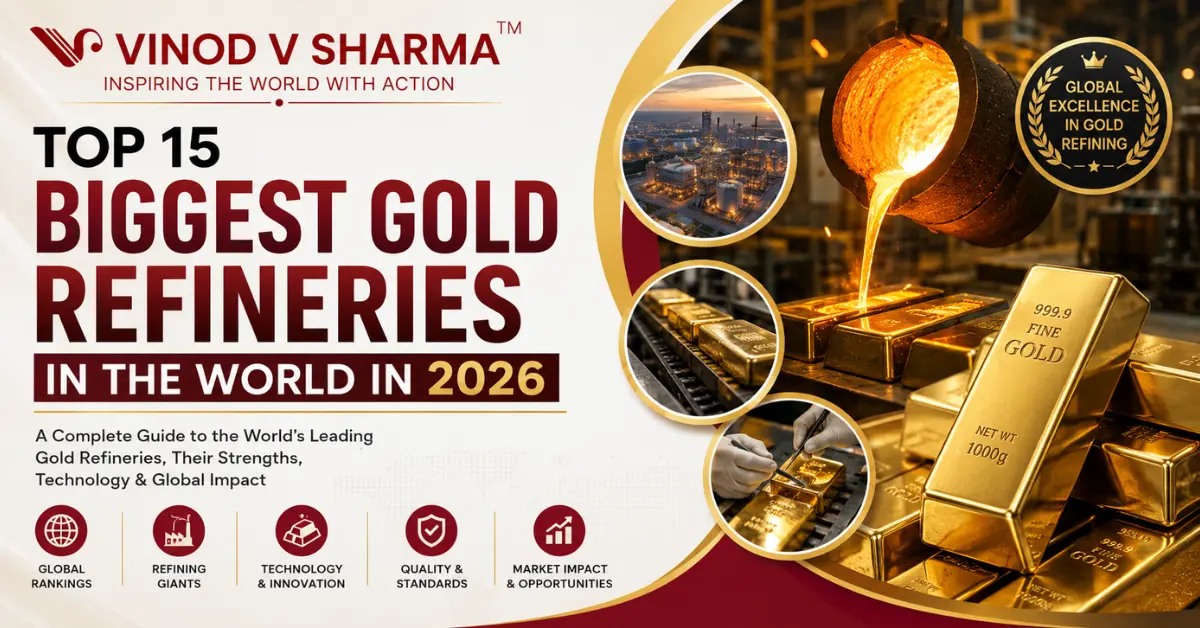
Top 15 Biggest Gold Refineries in the World in 2026
1. Valcambi – Switzerland
Valcambi is one of the world’s best-known precious-metals refining and manufacturing companies and is based in Balerna, Switzerland.
Its importance comes not only from refining capacity but also from its extensive product manufacturing capabilities. Valcambi works across gold, silver, platinum, and palladium and produces cast and minted bars, coins, granules, alloys, and specialised precious-metal products.
The company has historically reported very substantial combined precious-metals refining capacity, demonstrating the scale of Switzerland’s refining infrastructure. Its operations also serve international mining companies, financial institutions, jewellery manufacturers, technology businesses, governments, and central banks.
One of Valcambi’s best-known innovations is its CombiBar concept, which allows a larger bar to be divided into smaller units without requiring traditional cutting or melting.
Why Valcambi matters
- Major Swiss precious-metals refiner
- Strong international bullion reputation
- Advanced bar and coin manufacturing
- Large-scale multi-metal refining capabilities
- Strong presence in institutional and investment markets
Valcambi represents the combination of Swiss refining expertise, precision manufacturing, security, and international bullion-market connectivity.
2. Metalor Technologies – Switzerland
Metalor Technologies is another major Swiss precious-metals company with a long history in refining and precious-metals manufacturing.
The company’s activities extend across refining, recycling, precious-metal products, and industrial applications. Its position in Switzerland places it within one of the world’s most important precious-metals processing ecosystems.
Metalor is particularly significant because its business model connects traditional bullion refining with industrial applications. Precious metals are essential in electronics, medical technology, jewellery, and advanced manufacturing, creating demand beyond the investment market.
Key strengths
- Swiss refining heritage
- Gold and precious-metals recycling.
- Industrial precious-metals applications
- International customer network
- Strong focus on quality and traceability
Metalor demonstrates why the world’s leading refiners cannot be viewed solely as gold-bar producers. Modern refining businesses increasingly operate across investment, industrial, jewellery, and recycling markets.
3. Rand Refinery – South Africa
Rand Refinery is one of Africa’s most strategically important precious-metals refineries.
Located in South Africa, the refinery has a unique position because South Africa has historically been one of the world’s major gold-producing regions. Rand Refinery therefore plays an important role in converting African-mined gold into internationally marketable precious-metal products.
The refinery is also deeply connected to the international bullion market and has an important technical role within the LBMA ecosystem. Rand Refinery states that its responsibilities include technical advice to LBMA, evaluation of Good Delivery applications, production of certified reference materials, and participation in proficiency testing and proactive monitoring.
Why Rand Refinery is important
- Major African precious-metals refining centre
- Strong historical connection to South African gold mining
- International bullion-market recognition
- Technical expertise in assaying and refining
- Strategic position within Africa’s gold supply chain
Rand Refinery is particularly important when assessing the role of Africa in the global gold industry.
4. Tanaka Kikinzoku Kogyo – Japan
Tanaka Kikinzoku Kogyo is a major Japanese precious-metals group with expertise spanning refining, manufacturing, recycling, industrial applications, and investment products.
Japan’s precious-metals industry is closely connected to advanced manufacturing, electronics, automotive technologies, jewellery, and high-precision industrial applications. This makes Tanaka different from refiners that focus primarily on investment bullion.
Gold is widely used in electronics and advanced technology because of its conductivity, corrosion resistance, and reliability. Tanaka’s business therefore illustrates how gold refining can support both financial markets and industrial supply chains.
Key strengths
- Advanced Japanese manufacturing expertise
- Precious-metal recycling
- Industrial gold applications
- Investment bullion products
- High-precision refining and manufacturing
Tanaka’s role demonstrates the increasingly important relationship between gold refining and technology.
5. PAMP – Switzerland
PAMP, part of the MKS PAMP group, is one of the most recognisable names in the global precious-metals market.
The brand is particularly well known among retail investors because of its investment bars, distinctive designs, security features, and international distribution.
PAMP’s importance extends beyond retail gold. Its operations connect refining, bullion manufacturing, precious-metal products, and institutional markets.
The brand has also played an important role in making professionally refined gold more accessible to individual investors through smaller bars and highly recognisable packaging.
Key strengths
- Globally recognised bullion brand
- Swiss precious-metals expertise
- Investment bars in multiple sizes
- Strong institutional and retail presence
- Advanced security and authentication features
PAMP is an excellent example of how a refinery can build a globally recognised consumer-facing bullion brand.
6. Argor-Heraeus – Switzerland
Argor-Heraeus is one of the most significant precious-metals refiners operating from Switzerland.
The company is particularly notable for its large-scale refining infrastructure. In 2025, reporting on the Swiss refining sector indicated that Argor-Heraeus had refining capacity of approximately 1,380 metric tonnes of gold per year, although actual throughput depends on market conditions and incoming material.
The refinery handles gold from international sources and uses advanced processes to produce high-purity precious metals.
Key strengths
- Very large stated gold-refining capacity
- Swiss location and infrastructure
- Strong international bullion presence
- Advanced refining and assaying
- Responsible sourcing and traceability focus
Argor-Heraeus highlights one of the defining characteristics of the Swiss gold industry: very large refining capabilities concentrated in a relatively small geographic area.
7. Heraeus Precious Metals – Germany
Heraeus Precious Metals is one of Germany’s major precious-metals businesses and operates across refining, recycling, manufacturing, and industrial applications.
The company is part of the wider Heraeus group, a global technology organisation with a long history in precious metals.
Heraeus is important because its business extends beyond conventional bullion. Its precious metals are used in industries such as automotive technology, electronics, hydrogen technologies, chemicals, jewellery, and investment products.
Why Heraeus matters
- Major European precious-metals group
- Refining and recycling capabilities
- Strong industrial customer base
- Advanced precious-metals technology
- International presence
The company’s position illustrates the increasingly circular nature of the gold industry, where recycled material can return to the supply chain through sophisticated recovery and refining processes.
8. Shandong Zhaojin Gold Refinery – China
China is one of the world’s most important gold markets, both as a producer and as a consumer.
Shandong Zhaojin Gold is associated with one of China’s major gold-industry groups and plays a role in the country’s extensive mining, processing, refining, and bullion ecosystem.
China’s gold market has a distinctive structure because domestic mine production, imported gold, recycling, jewellery demand, investment demand, and exchange-based bullion activity all interact.
Key strengths
- Strong connection to China’s gold-mining industry
- Access to one of the world’s largest gold markets
- Domestic bullion and jewellery-market relevance
- Large-scale precious-metals processing ecosystem
- Strategic importance within Asia
China’s refining sector is increasingly important to understanding the future direction of the global gold market.
9. Yuexin Precious Metals – China
Yuexin Precious Metals represents China’s growing presence in modern precious-metals refining and processing.
Chinese refiners operate within an ecosystem supported by large-scale domestic manufacturing, jewellery demand, investment markets, recycling, and precious-metals trading.
The importance of refiners such as Yuexin is therefore not limited to their individual production capacity. They are part of a broader Chinese precious-metals infrastructure that continues to develop alongside the country’s financial and industrial markets.
Key areas of importance
- Gold refining and precious-metals processing
- Domestic Chinese bullion supply
- Recycling and secondary gold
- Jewellery-industry demand
- Asian precious-metals market integration
China’s growing role demonstrates that the centre of gravity for gold refining is no longer limited to Europe and South Africa.
10. Perth Mint – Australia
The Perth Mint is one of the most important gold refining and bullion institutions in the Asia-Pacific region.
Its refinery processed 225.4 tonnes of gold in 2024–25, according to its latest annual reporting, while the organisation states that the refinery has capacity to refine more than 800 tonnes of gold per year. It also reported refining approximately 71% of Australia’s newly mined gold in 2024–25.
The Perth Mint is particularly notable for its integration of refining, bullion manufacturing, storage, investment products, and precious-metals services.
It is also accredited across major global precious-metals markets and produces both large institutional bars and smaller investment products.
Key strengths
- Large Australian refining operation
- Government of Western Australia ownership
- Strong Asia-Pacific market position
- Gold and silver refining
- Investment bullion manufacturing
- Advanced automation and refining technology
The Perth Mint is one of the clearest examples of a modern integrated precious-metals institution.
11. Royal Canadian Mint – Canada
The Royal Canadian Mint operates one of the world’s respected precious-metals refining and bullion manufacturing facilities.
Its refining operations are particularly known for high-purity gold. The Mint states that it introduced a 99.99% pure gold bullion coin in 1982 and later achieved 99.999% purity in 1998.
Its refinery produces gold and silver products and works with London Good Delivery and COMEX exchange bars.
The Mint’s refining process can involve pre-melting, chemical purification, anode casting, electrolysis, and final casting. Its processes can achieve gold purity levels of 99.99% and 99.999%.
Key strengths
- Canadian government mint
- High-purity gold expertise
- Refining and bullion manufacturing
- Strong institutional reputation
- London Good Delivery and COMEX market relevance
The Royal Canadian Mint combines refining expertise with a globally recognised bullion and coin manufacturing operation.
12. Asahi Refining – United States & Canada
Asahi Refining is a major North American precious-metals refining organisation serving the bullion, investment, mining, and recycling markets.
Its strategic importance comes from its North American footprint and its position within the supply chain for gold and silver.
Refining in North America is particularly important because the region contains large investment markets, financial institutions, mining operations, jewellery businesses, and exchange-related precious-metals infrastructure.
Key strengths
- North American refining footprint
- Gold and silver refining
- Recycling capabilities
- Institutional bullion-market relationships
- Investment-bar production
Asahi Refining is therefore an important part of the North American precious-metals ecosystem.
13. MMTC-PAMP – India
MMTC-PAMP is one of India’s most important organised gold-refining and bullion-manufacturing businesses.
India has a unique relationship with gold. The country has enormous jewellery demand, a large investment market, significant gold imports, and an expanding organised refining sector.
A 2025 industry analysis filed with India’s National Stock Exchange identified MMTC-PAMP as having the highest gold-refining capacity among the BIS-accredited refineries considered in its analysis, at approximately 300 tonnes per year.
MMTC-PAMP also has international recognition through its presence on the LBMA Good Delivery framework. The LBMA’s current-list information identifies an MMTC-PAMP refinery location in Haryana and records its current bar mark.
Why MMTC-PAMP matters
- Major organised Indian gold refiner
- Approximately 300-tonne annual capacity cited in industry analysis
- LBMA Good Delivery recognition
- Strong Indian bullion-market presence
- Gold bars and investment products
- Strong connection to India’s jewellery and investment sectors
India’s position in global gold refining is expected to remain important as organised refining and recycling continue to develop.
14. C. Hafner – Germany
- Hafner is a German precious-metals company with expertise in refining, recycling, and precious-metal manufacturing.
The company is particularly associated with the recovery and circular use of precious metals.
This is increasingly important because the future supply of gold will not depend only on newly mined production. Recycling old jewellery, industrial materials, electronic components, and other precious-metal-bearing products can provide a significant secondary source of gold.
Key strengths
- German precious-metals expertise
- Refining and recycling
- Circular-economy focus
- Industrial precious-metals applications
- High-purity precious-metal products
- Hafner illustrates the importance of recycling as the gold industry moves toward more sustainable resource utilisation.
15. United States Mint and Major U.S. Refining Operations
This category requires an important clarification.
The United States Mint should not be treated as a conventional commercial gold refinery in exactly the same way as Valcambi, PAMP, or Rand Refinery. The U.S. Mint is primarily a government mint responsible for producing circulating coinage, bullion coins, medals, and other numismatic products.
However, the United States has a major precious-metals refining and processing ecosystem involving private refiners, assayers, bullion dealers, exchanges, vault operators, and government institutions.
For a global overview, it is useful to include the U.S. market because of its enormous importance to investment gold, COMEX-linked bullion markets, institutional trading, and precious-metals storage.
Why the U.S. market matters
- Major global investment-gold market
- Important bullion trading infrastructure
- COMEX precious-metals ecosystem
- Large private refining industry
- Strong institutional demand
- Significant gold recycling market
For accuracy, readers should distinguish between the U.S. Mint as a government mint and private U.S. commercial refining companies.
Comparing the Top 15 Gold Refineries in 2026
| Refinery / Organisation | Country or Region | Major Strength | Global Significance |
| Valcambi | Switzerland | Large-scale refining and manufacturing | Very High |
| Metalor Technologies | Switzerland | Refining, recycling and industrial metals | Very High |
| Rand Refinery | South Africa | African gold refining | Very High |
| Tanaka Kikinzoku Kogyo | Japan | Technology and precious metals | Very High |
| PAMP | Switzerland | Investment bullion and refining | Very High |
| Argor-Heraeus | Switzerland | Large-scale gold refining | Very High |
| Heraeus Precious Metals | Germany | Refining, recycling and technology | Very High |
| Shandong Zhaojin Gold | China | Chinese gold ecosystem | High |
| Yuexin Precious Metals | China | Chinese refining and processing | High |
| Perth Mint | Australia | Refining and bullion manufacturing | Very High |
| Royal Canadian Mint | Canada | High-purity refining and bullion | High |
| Asahi Refining | U.S. & Canada | North American refining | High |
| MMTC-PAMP | India | Indian refining and bullion | Very High |
| C. Hafner | Germany | Recycling and precious metals | High |
| U.S. Mint / U.S. refining ecosystem | United States | Bullion and investment market | Very High |
Important: This table is a qualitative comparison rather than an official capacity ranking. Published capacity, actual throughput, refinery ownership structures, and reporting periods vary significantly between companies.
Switzerland: The Global Gold Refining Powerhouse
Switzerland has an extraordinary position in the global gold-refining industry.
The country is home to several internationally recognised refiners, including Valcambi, Metalor, PAMP and Argor-Heraeus. Swiss refiners benefit from decades of technical expertise, established financial infrastructure, skilled labour, secure logistics, and proximity to major European markets.
Switzerland’s importance is not simply a result of domestic gold production. The country imports gold-bearing material from international markets and processes it into products suitable for global distribution.
The Swiss refining model combines:
- Advanced refining technology
- High-quality assaying
- Secure transportation
- Strong financial infrastructure
- International bullion relationships
- Investment-bar manufacturing
- Jewellery and industrial applications
The scale of Switzerland’s refining industry means that changes in global gold flows can have a direct impact on Swiss refineries.
Africa’s Role in Global Gold Refining
Africa remains one of the world’s most important gold-producing regions.
Countries such as South Africa, Ghana, Mali, Burkina Faso, Tanzania and others contribute significantly to African gold production. However, mining and refining are two different stages of the supply chain.
A major challenge for African economies is capturing more value locally rather than exporting lower-value intermediate material for processing elsewhere.
Rand Refinery represents an important example of sophisticated African refining infrastructure.
The future of African refining could involve:
- Greater domestic refining capacity
- Better traceability
- Formalisation of artisanal mining
- Improved environmental standards
- Regional bullion hubs
- Greater participation in international bullion markets
If more African gold is refined closer to its source, producing countries could potentially capture additional value from the supply chain.
Asia’s Growing Gold Refining Industry
Asia has become increasingly important to the global gold market.
China and India are particularly significant because both countries have enormous gold markets.
China combines gold mining, refining, manufacturing, investment and exchange-based trading. India, meanwhile, has enormous jewellery demand and a rapidly developing organised refining industry.
Japan adds another dimension through advanced technology and precious-metal recycling, particularly in electronics and industrial applications.
The Asian gold-refining industry is therefore supported by several demand centres:
- Jewellery
- Investment bars
- Coins
- Central banks
- Electronics
- Industrial technology
- Recycling
- Manufacturing
This diversification gives Asian refiners an important role in the future of the global precious-metals market.
Gold Refining Technology and Innovation
Gold refining has changed dramatically over time.
Traditional refining methods have been supplemented by highly advanced technologies capable of producing extremely pure gold while recovering other valuable metals.
Modern facilities may use:
Chemical Refining
Chemical processes dissolve or separate gold from unwanted materials and allow refiners to recover extremely high-purity metal.
Electrolysis
Electrolytic refining uses electrical current to separate gold from impurities. The Royal Canadian Mint describes electrolysis as a key step in achieving gold purity of 99.99% or 99.999%.
Advanced Assaying
Assaying determines the precise concentration of gold and other elements. Accurate assays are essential because even a small difference in purity can represent a significant financial value when dealing with large quantities.
Automated Casting
Modern refineries increasingly use automated casting systems to improve consistency, safety, weight accuracy and productivity.
The Perth Mint, for example, has invested in automated gold and silver casting lines, advanced granulation systems and enclosed refining processes.
Digital Traceability
Digital records, serial numbers, security features, documentation and supply-chain monitoring are becoming increasingly important for demonstrating the origin and authenticity of gold.
The Importance of LBMA Good Delivery Standards
The LBMA Good Delivery system is one of the most important quality frameworks in the international bullion market.
LBMA explains that only refiners whose approved bars meet its stringent requirements are included on the Good Delivery List.
The standard covers critical characteristics including:
- Fine gold content
- Weight
- Purity
- Appearance
- Markings
- Assaying
- Quality assurance
- Responsible sourcing requirements
A typical London Good Delivery gold bar is approximately 400 troy ounces.
The importance of the standard is straightforward: international bullion trading requires participants to trust the quality and identity of physical bars.
Without common standards, every transaction would require extensive independent testing.
Good Delivery therefore reduces friction and increases confidence in institutional gold markets.
However, Good Delivery status should not be confused with a ranking of refinery size. It indicates that eligible bars from a particular refinery location meet LBMA’s requirements; it does not automatically mean that the refiner is the world’s largest.
Responsible Gold Refining and Supply-Chain Transparency
Responsible sourcing has become one of the defining issues for the modern gold industry.
Gold can originate from many different sources, including large-scale mines, artisanal and small-scale mining operations, recycled jewellery, industrial materials, and other secondary sources.
The challenge is determining whether gold entering the refining system has been sourced responsibly.
Important areas include:
- Human rights
- Environmental protection
- Conflict risks
- Illegal mining
- Money laundering risks
- Sanctions compliance
- Supply-chain documentation
- Artisanal and small-scale mining risks
- Anti-corruption controls
LBMA’s Responsible Gold Guidance provides a framework for Good Delivery refiners and is aligned with international due-diligence principles, including the OECD framework for responsible mineral supply chains. In June 2026, LBMA launched a public consultation for Version 10 of its Responsible Gold Guidance.
This trend means that refinery competitiveness is no longer determined only by capacity and cost.
Trust, traceability and responsible sourcing are becoming equally important.
Gold Refineries and the Global Bullion Market
Refineries provide the physical foundation for the bullion market.
Once gold has been refined to the required purity, it can enter several markets:
Institutional Bullion
Large gold bars are used by banks, institutional investors, central banks and bullion-market participants.
Retail Investment
Smaller bars and coins allow individual investors to gain exposure to physical gold.
Jewellery
Refined gold can be converted into jewellery alloys and manufacturing materials.
Technology
Gold’s conductivity, corrosion resistance and reliability make it valuable in electronics and advanced technology.
Central Banks
Central banks can hold gold as part of their reserve assets.
The refinery therefore sits at a crucial point between physical supply and financial demand.
Investment Opportunities Created by Gold Refining
Gold refining itself is generally not a simple investment category for individual investors because large refineries are often privately held, government-owned, subsidiaries, or parts of diversified industrial groups.
However, investors can gain indirect exposure to the broader gold-refining ecosystem through several avenues.
1. Precious-Metals Companies
Some publicly listed companies have exposure to refining, recycling, mining, bullion manufacturing or precious-metals services.
2. Gold Mining Companies
Mining companies supply raw material to refiners and therefore participate in the upstream part of the same ecosystem.
3. Gold ETFs
Gold-backed exchange-traded products provide exposure to gold prices without requiring investors to own refinery shares or physical bars directly.
4. Physical Gold
Refinery-branded investment bars can provide direct physical exposure to gold, subject to premiums, storage, insurance, authentication and liquidity considerations.
5. Precious-Metals Recycling
Companies involved in precious-metal recycling may benefit from growing demand for secondary gold and improved recovery technologies.
Investors should remember that a highly respected refinery is not automatically a profitable investment. Refining businesses can face energy costs, working-capital requirements, metal-price volatility, regulatory obligations, security costs, and supply-chain risks.
The Future of Gold Refining in 2026 and Beyond
The gold-refining industry is likely to experience several major changes over the coming years.
Greater Demand for Traceability
Customers, regulators and institutional investors are increasingly interested in knowing where gold originated and how it moved through the supply chain.
More Recycling
As the world’s above-ground gold stock grows, recycled gold will remain an important source of supply.
Efficient recycling can recover gold from:
- Jewellery
- Electronics
- Industrial components
- Investment products
- Manufacturing waste
Increased Automation
Robotics, automated casting, digital monitoring and advanced analytical systems can improve efficiency while reducing workplace risks.
Cleaner Refining
Refineries are under increasing pressure to reduce energy consumption, emissions, chemical waste and other environmental impacts.
Higher Purity and Product Customisation
Investment markets increasingly demand products ranging from large institutional bars to gram-sized investment products.
Regional Refining Hubs
Countries with large gold production or consumption markets may seek to develop stronger domestic refining capabilities.
Stronger Responsible-Sourcing Requirements
Responsible sourcing is likely to become an even more important part of refinery accreditation and international bullion trading.
How Investors Can Evaluate a Gold Refinery
If you are researching a gold refinery as part of an investment or business analysis, consider the following factors.
1. Check Refining Capacity
Look for independently reported or company-published capacity figures.
2. Separate Capacity From Actual Throughput
A refinery’s maximum theoretical capacity can be much higher than its actual annual production.
3. Verify LBMA Status
Check the current LBMA Good Delivery List rather than relying only on marketing claims. LBMA maintains the official current list and updates refinery information over time.
4. Examine Ownership
Determine whether the refinery is:
- Privately owned
- Government owned
- Publicly listed
- A subsidiary
- Part of a diversified industrial group
5. Analyse the Source of Gold
Understand whether the refinery primarily handles:
- Mine doré
- Recycled gold
- Imported material
- Jewellery scrap
- Industrial materials
6. Study Responsible-Sourcing Policies
Look for public information regarding supply-chain due diligence, audits, certifications and responsible sourcing.
7. Evaluate Technology
Advanced technology can improve recovery rates, purity, safety and operating efficiency.
8. Consider Market Access
A refinery’s relationships with banks, exchanges, mining companies, jewellery manufacturers and investors can significantly influence its commercial strength.
9. Review Financial Performance
For publicly reporting companies, examine revenue, margins, capital expenditure, working capital, debt and cash flow.
10. Evaluate Regulatory Risk
Precious-metals refiners operate in highly regulated environments. Compliance failures can damage reputation and restrict access to important markets.
Key Takeaways From the World’s Major Gold Refineries
The global gold-refining industry is much more diverse than a simple ranking suggests.
Switzerland remains one of the world’s most important refining centres, with several internationally recognised refiners operating within a sophisticated financial and industrial ecosystem.
South Africa continues to provide strategic refining infrastructure for Africa, while Australia benefits from The Perth Mint’s large-scale integrated refining and bullion operation.
China, India and Japan demonstrate the growing importance of Asia through mining, jewellery, investment demand, technology and recycling.
Germany and other European markets contribute significant refining, recycling and industrial expertise, while North America remains crucial because of its large investment markets and financial infrastructure.
One of the clearest conclusions is that refinery size alone does not determine global importance.
A refinery may be influential because of:
- Refining capacity
- Actual throughput
- Good Delivery recognition
- Bullion-market relationships
- Technology
- Responsible sourcing
- Geographic position
- Recycling capability
- Investment-product manufacturing
- Industrial applications
Conclusion
The world’s leading gold refineries are fundamental to the modern gold economy.
From Switzerland’s sophisticated refining network to Rand Refinery’s role in Africa, The Perth Mint’s Asia-Pacific position, India’s rapidly developing refining industry, China’s expanding precious-metals ecosystem, Japan’s technology-driven operations, and North America’s large bullion market, these organisations connect gold producers with financial markets, manufacturers, jewellers, governments and investors.
In 2026, the definition of a leading gold refinery is evolving. Capacity remains important, but it is only one part of the equation. Refinery quality, assaying accuracy, responsible sourcing, traceability, technology, recycling capabilities and access to international bullion markets are becoming equally significant.
The LBMA Good Delivery framework remains a critical benchmark for internationally traded gold bars, helping market participants establish confidence in the quality and consistency of physical bullion.
For investors and industry professionals, the most useful approach is therefore not simply to ask, “Which refinery is the biggest?” Instead, the better question is:
“Which refinery combines scale, quality, technology, responsible sourcing, market access and long-term credibility?”
That broader perspective provides a more accurate understanding of why the world’s leading gold refineries matter—and why their role is likely to become even more important as the global gold market evolves through 2026 and beyond.