
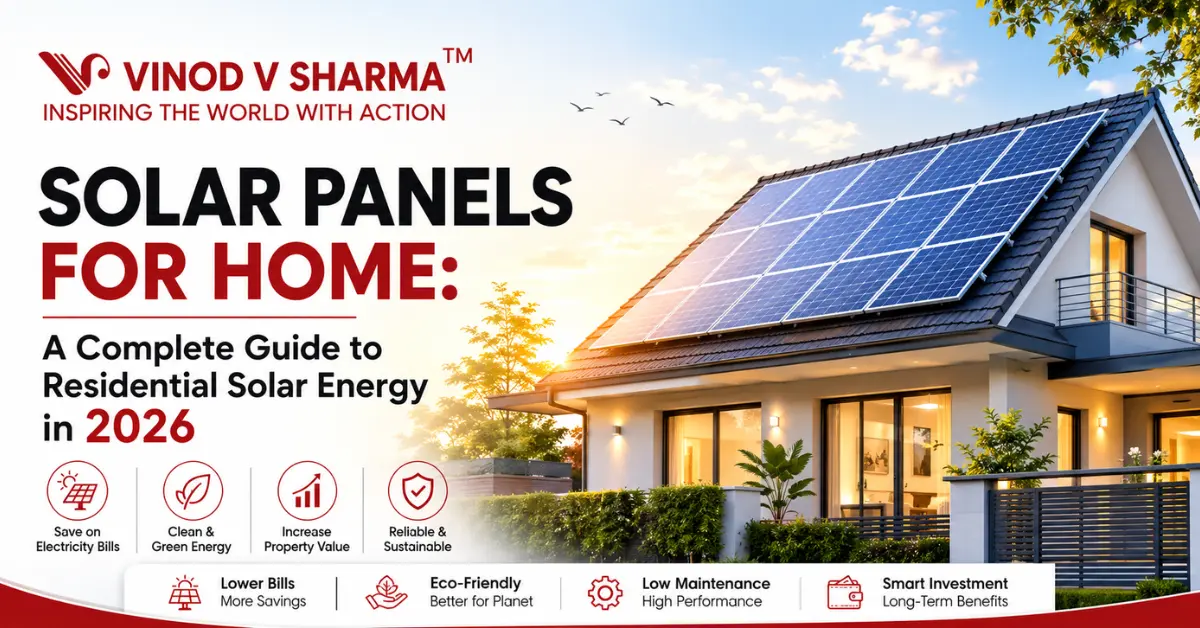
Solar energy has moved from being an alternative energy source to becoming a practical option for homeowners looking to reduce electricity costs and adopt cleaner energy. In 2026, improvements in solar technology, greater awareness of energy efficiency, and the growing availability of rooftop solar programmes are encouraging more households to consider installing solar panels.
For homeowners, a solar power system can generate electricity from sunlight and, depending on the system configuration and local regulations, either supply that electricity directly to the home, store excess energy in batteries, or export surplus electricity to the grid.
India is particularly well positioned for residential solar because many regions receive substantial sunlight throughout the year. The combination of rising electricity consumption, increasing interest in energy independence, and government support for rooftop solar has strengthened the residential solar market.
However, choosing a solar system involves more than simply purchasing panels. Homeowners need to consider electricity consumption, available roof space, system capacity, panel technology, inverter selection, installation quality, financing, maintenance, warranties, and applicable regulations.
This comprehensive guide explains how solar panels work, how much a home solar system can cost, how to determine the right system size, potential savings, installation requirements, government incentives in India, maintenance, safety, and the long-term outlook for residential solar energy in 2026.
What Are Solar Panels for Home?
Solar panels for home are photovoltaic (PV) modules designed to convert sunlight into electrical energy that can be used to power household appliances and electrical equipment.
A solar panel consists of multiple photovoltaic cells. When sunlight strikes these cells, they generate direct current (DC) electricity. Because most household appliances operate using alternating current (AC), a solar inverter is normally used to convert the electricity into a usable form.
A residential solar installation can range from a relatively small system designed to offset part of a home’s electricity consumption to a larger system capable of supplying a significant portion of household energy requirements.
The appropriate system depends on factors such as:
- Monthly electricity consumption
- Roof size and available installation area
- Local solar conditions
- Budget
- Desired level of energy independence
- Battery requirements
- Grid availability
- Applicable government policies and regulations
For many homeowners, rooftop solar is attractive because it allows unused roof space to become a source of electricity without requiring additional land.
How Do Residential Solar Panels Work?
The basic operation of a residential solar system is relatively straightforward.
Step 1: Solar Panels Capture Sunlight
Solar panels absorb sunlight through photovoltaic cells. The cells convert solar radiation into DC electricity.
Step 2: Electricity Travels to the Inverter
The DC electricity generated by the panels is sent to a solar inverter.
Step 3: The Inverter Converts DC to AC
The inverter converts DC electricity into alternating current (AC), which can be used by household appliances.
Step 4: The Home Uses Solar Electricity
The generated electricity can power lights, fans, refrigerators, televisions, computers, pumps, air conditioners, and other electrical appliances, depending on system capacity and available generation.
Step 5: Excess Electricity Is Managed
If the system generates more electricity than the home is consuming, the surplus may be:
- Stored in a battery, if a battery system is installed; or
- Exported to the electricity grid under an applicable net-metering or other approved arrangement.
When solar generation is insufficient, electricity can be supplied by the battery or the utility grid, depending on the system configuration.
Key Components of a Home Solar Power System
A residential solar installation includes several components that work together.
Solar Panels
Solar panels are the primary electricity-generating component. They convert sunlight into DC electricity.
Solar Inverter
The inverter converts DC electricity generated by the panels into AC electricity for household use. It may also monitor system performance and provide important protection functions.
Mounting Structure
Mounting structures securely attach solar panels to the roof or another suitable surface. They must be designed to withstand local environmental conditions.
Solar Battery
A battery stores electricity for later use. Batteries are particularly useful in systems designed to provide backup power or increase self-consumption.
Net Meter
Where permitted, a bidirectional or net meter can measure electricity flowing between the home and the electricity grid.
Monitoring System
Modern solar systems may include monitoring software or hardware that allows homeowners to track electricity generation, system performance, and other operating information.
Types of Solar Panel Systems for Homes
Residential solar systems are generally classified into three main categories.
On-Grid Solar System
An on-grid system is connected to the electricity grid. Solar electricity is used by the home, while excess generation can potentially be exported to the grid under the applicable utility arrangement.
Advantages:
- Generally lower cost than battery-based systems
- Can reduce electricity purchases from the grid
- Suitable for homes with reliable grid access
- No battery replacement requirement
One important consideration is that standard grid-connected systems generally shut down during a grid outage unless they are specifically designed with appropriate backup functionality.
Off-Grid Solar System
An off-grid system operates independently of the utility grid and normally requires battery storage.
Advantages:
- Can provide electricity where grid access is unavailable
- Greater energy independence
- Can support electricity availability when properly designed and sized
However, batteries increase the initial investment and require careful sizing and maintenance.
Hybrid Solar System
A hybrid system combines solar generation, battery storage, and grid connectivity.
It can allow homeowners to use solar electricity, store surplus generation, draw electricity from the grid when necessary, and potentially use stored energy during outages, depending on the equipment configuration.
Types of Solar Panels for Residential Use
Several solar panel technologies are available for residential applications.
Monocrystalline Solar Panels
Monocrystalline panels are manufactured using monocrystalline silicon cells and are widely used in residential installations.
They are generally known for:
- High efficiency
- Good performance per unit of roof area
- Long operating life
- Attractive appearance
Polycrystalline Solar Panels
Polycrystalline panels are manufactured using multiple silicon crystal structures.
They have historically been popular because of their relatively straightforward manufacturing process and competitive pricing, although newer high-efficiency technologies have changed the residential market considerably.
Thin-Film Solar Panels
Thin-film panels use semiconductor materials deposited in thin layers.
They can offer advantages in specific applications but typically require more space for a comparable amount of electricity generation than many crystalline-silicon technologies.
Which Type Is Best for a Home?
There is no single panel technology that is ideal for every property. Homeowners should evaluate efficiency, available roof space, product quality, warranty, degradation characteristics, installation conditions, price, and expected lifetime before making a decision.
Benefits of Installing Solar Panels at Home
Residential solar can provide several financial, environmental, and energy-related benefits.
1. Lower Electricity Bills
Generating electricity on-site can reduce the amount of electricity a household needs to purchase from the grid.
2. Renewable Energy
Solar power uses sunlight rather than fossil fuels to generate electricity, helping households transition toward cleaner energy.
3. Greater Energy Independence
A properly designed solar-plus-storage system can reduce dependence on the electricity grid.
4. Long-Term Energy Savings
Although installation requires an upfront investment, a solar system can continue generating electricity for many years.
5. Reduced Carbon Footprint
Using solar electricity can reduce dependence on electricity generated from fossil-fuel sources.
6. Better Use of Rooftop Space
Rooftops that would otherwise remain unused can become productive energy-generating areas.
7. Potential Property Appeal
Energy-efficient homes with renewable-energy systems may be attractive to environmentally conscious buyers, although the actual effect on property value varies by market.
How Much Do Solar Panels Cost for a Home in 2026?
The cost of a residential solar installation varies significantly depending on system size, equipment, installation conditions, location, inverter technology, mounting requirements, battery storage, and applicable subsidies.
A basic solar installation can include:
- Solar panels
- Inverter
- Mounting structures
- Wiring and electrical protection
- Installation labour
- Metering-related work
- Commissioning
Adding battery storage can substantially increase the overall cost.
Rather than relying on a single market-wide price, homeowners should obtain quotations based on their specific electricity consumption and property.
For Indian homeowners, it is also important to determine whether the project qualifies for any current government subsidy or incentive before calculating the final investment.
Factors That Affect Home Solar Installation Costs
Several factors influence the total project cost.
System Capacity
Larger systems generally require more panels, a larger inverter, additional mounting material, and more installation work.
Panel Technology
Higher-efficiency panels can cost more but may be beneficial where roof space is limited.
Inverter Type
String, microinverter, hybrid, and other inverter configurations have different costs and capabilities.
Battery Storage
Adding batteries can significantly increase the upfront investment.
Roof Structure
Complex roofs may require additional engineering, mounting components, or labour.
Electrical Work
Upgrades to electrical infrastructure can add to installation costs.
Location
Labour, logistics, local regulations, and installation conditions can affect pricing.
Government Incentives
Eligible subsidies can reduce the net cost for qualifying homeowners.
How Many Solar Panels Does Your Home Need?
The number of panels required depends primarily on the desired system capacity and the wattage of the selected panels.
For example, a 3 kW system could use approximately:
- 6 × 500 W panels
- 7 × 450 W panels
- 8 × 400 W panels
The exact configuration depends on available panel models, inverter specifications, roof layout, and system design.
However, calculating the number of panels based only on household size is not recommended.
A better approach is to examine actual electricity consumption, preferably using several months of electricity bills.
Choosing the Right Solar System Size for Your Home
Solar systems are commonly discussed in kilowatts (kW).
1 kW Solar System
Suitable for homes with relatively low electricity consumption or limited available roof space.
2 kW Solar System
May suit smaller households with moderate electricity requirements.
3 kW Solar System
A commonly considered size for residential applications with moderate electricity consumption.
5 kW Solar System
Suitable for households with higher electricity consumption and sufficient roof space.
10 kW Solar System
Generally more appropriate for large homes, high-consumption properties, or applications with significant electricity demand.
The correct capacity should be determined through an energy assessment rather than simply choosing the largest system affordable.
How Much Electricity Can Home Solar Panels Generate?
Solar generation depends on several variables, including:
- Installed capacity
- Solar irradiation
- Location
- Panel orientation
- Panel tilt
- Shading
- Temperature
- System losses
- Inverter performance
- Dust and dirt
- Weather conditions
For example, a 5 kW solar system does not generate 5 kWh of electricity every hour. Its output changes throughout the day and depends on sunlight conditions.
Generation is generally highest around the middle of a sunny day and significantly lower during early morning, late afternoon, cloudy weather, or periods of heavy rain.
Homeowners should therefore evaluate solar generation using expected daily, monthly, and annual energy output rather than panel capacity alone.
How Much Can You Save on Your Electricity Bill With Solar?
The potential savings from residential solar depend on how much electricity the system generates and how that electricity is used.
Important factors include:
- Solar system size
- Household electricity consumption
- Electricity tariff
- Daytime electricity usage
- Net-metering or other grid-export arrangements
- Battery storage
- System performance
- Local regulations
A home that consumes a large portion of its electricity during daylight hours may be able to directly use more solar generation.
For an accurate estimate, homeowners should compare annual electricity consumption with estimated annual solar generation and then calculate the value of electricity produced and, where applicable, exported.
Solar Panel Efficiency: What Homeowners Should Know
Solar panel efficiency refers to the percentage of sunlight that a panel can convert into electricity under specified test conditions.
Higher efficiency can be particularly valuable when roof space is limited because more electricity can potentially be generated from a smaller installation area.
However, efficiency should not be the only purchasing criterion.
Homeowners should also consider:
- Product warranty
- Performance warranty
- Degradation rate
- Temperature characteristics
- Manufacturer reputation
- Certification
- Installer quality
- Total system cost
A slightly more efficient panel is not automatically the best choice if the overall system design or installation quality is poor.
Solar Panel Installation Process for Homes
A professional residential solar installation generally follows several stages.
Step 1: Analyse Electricity Consumption
Review recent electricity bills to understand household energy requirements.
Step 2: Determine System Capacity
Estimate the appropriate solar capacity based on consumption, budget, roof space, and energy goals.
Step 3: Conduct a Site Assessment
The installer evaluates roof condition, orientation, shading, structural suitability, and electrical infrastructure.
Step 4: Select Equipment
Choose suitable panels, inverter, mounting system, protection equipment, and batteries if required.
Step 5: Install the Mounting Structure
The mounting system is securely installed on the roof.
Step 6: Install Solar Panels
Panels are mounted and electrically connected.
Step 7: Install the Inverter and Electrical Equipment
The inverter, protection devices, wiring, and other required components are installed.
Step 8: Grid Connection and Metering
For grid-connected systems, the required utility approval and metering process is completed according to local rules.
Step 9: Testing and Commissioning
The installer checks system performance and safety before putting the system into operation.
Roof Requirements for Installing Solar Panels
A suitable roof is essential for a successful residential solar installation.
Ideally, the roof should have:
- Adequate structural strength
- Sufficient usable area
- Good sunlight exposure
- Minimal shading
- Suitable orientation
- A surface condition that can support long-term installation
Homeowners should also consider whether the roof may require repair or replacement before installing solar panels.
Installing panels on a roof that requires major repairs can create additional costs later.
Best Roof Direction and Tilt for Solar Panels
Solar panel orientation and tilt influence energy generation.
In India, the south-facing direction is often favourable for fixed rooftop solar systems, but the best orientation depends on the property’s location, roof geometry, shading, and system design.
Tilt angle also varies depending on geographical location and installation objectives.
A professional installer should evaluate:
- Latitude
- Roof orientation
- Roof pitch
- Shading
- Seasonal sunlight
- Nearby buildings and trees
Avoiding shade is particularly important because even partial shading can affect system performance.
Solar Panels for Different Types of Homes
Independent Houses
Independent homes often provide greater freedom to install rooftop systems because the homeowner controls the roof.
Villas
Villas can benefit from solar systems when sufficient roof area is available.
Apartments
Apartment residents may face additional challenges because the rooftop may be shared. Solar solutions may require approval from the housing association or building management.
Rural Homes
Solar can be particularly valuable in locations where grid electricity is unreliable or unavailable, especially when combined with battery storage.
Solar Batteries for Home: Are They Necessary?
A battery is not always necessary for a residential solar system.
For many grid-connected homes, solar electricity can be consumed directly during the day, while surplus generation can be managed through the applicable grid arrangement.
However, batteries can be valuable when homeowners want:
- Backup electricity during outages
- Greater energy independence
- Higher self-consumption
- Reduced dependence on grid electricity
Battery systems also have limitations, including higher upfront costs, finite operating life, efficiency losses, and eventual replacement requirements.
On-Grid vs Off-Grid vs Hybrid Solar: Which Is Best for Your Home?
| Grid connection | Yes | No | Yes |
| Battery required | Usually no | Yes | Usually yes |
| Backup capability | Usually limited without special equipment | Yes | Yes |
| Energy independence | Moderate | High | High |
| Initial cost | Generally lower | Higher | Higher |
| Suitable for | Grid-connected homes | Remote areas | Homes wanting solar + storage |
The best system depends on the homeowner’s priorities.
For a home with reliable grid electricity and a goal of reducing electricity bills, an on-grid system may be attractive.
For a property without reliable grid access, an off-grid system may be more appropriate.
For homeowners seeking solar generation, grid connectivity, and battery backup, a hybrid system may be worth considering.
Solar Panel Maintenance and Cleaning
Solar panels generally require relatively low maintenance, but regular inspection helps maintain performance.
Important maintenance activities include:
- Cleaning accumulated dust and dirt
- Checking cables and electrical connections
- Inspecting mounting structures
- Monitoring system performance
- Checking for physical damage
- Removing excessive vegetation or shading
- Scheduling professional inspections when necessary
Cleaning frequency depends on local environmental conditions. Areas with high dust, pollution, or agricultural activity may require more frequent cleaning.
Always follow the manufacturer’s safety instructions when cleaning or inspecting panels.
How Long Do Residential Solar Panels Last?
Modern solar panels are designed for long-term operation and commonly carry performance warranties extending for decades.
Over time, solar panels gradually experience performance degradation, meaning their electricity output slowly declines.
The actual lifespan depends on:
- Panel quality
- Installation conditions
- Climate
- Maintenance
- Environmental exposure
- Manufacturer specifications
Other system components, particularly inverters and batteries, may have different service lives and replacement cycles.
Therefore, homeowners should evaluate the expected lifetime of the entire solar system, not just the panels.
Solar Panel Warranty: What Should Homeowners Check?
A solar purchase may include multiple warranties.
Product Warranty
Covers manufacturing defects and certain product-related issues.
Performance Warranty
Provides a stated minimum level of power output over a specified period.
Inverter Warranty
Covers the inverter for the manufacturer’s specified warranty period.
Installation Warranty
May cover workmanship or installation-related defects.
Before purchasing, homeowners should carefully check:
- Warranty duration
- Warranty exclusions
- Claim process
- Service availability
- Replacement conditions
- Who is responsible for warranty support
A longer warranty is useful only when it comes from a manufacturer or installer capable of providing reliable after-sales support.
Government Subsidies and Incentives for Residential Solar in India
Government support has played an important role in expanding rooftop solar adoption in India.
Residential consumers may be eligible for incentives under applicable national or state-level programmes, subject to current eligibility criteria, system specifications, approved vendors, and other requirements.
The PM Surya Ghar: Muft Bijli Yojana is a major national rooftop solar programme focused on supporting residential rooftop solar adoption.
Because subsidy amounts, eligibility rules, application procedures, and programme guidelines can change, homeowners should verify the latest information through official government sources before making financial decisions.
Net Metering for Home Solar Systems: How Does It Work?
Net metering allows eligible grid-connected solar consumers to account for electricity exported to and imported from the electricity grid according to applicable regulations.
For example, during a sunny afternoon, a home may generate more electricity than it is consuming. The surplus may be exported to the grid.
At another time, such as at night, the home may consume electricity from the grid.
The applicable billing mechanism determines how these electricity flows are accounted for.
Because net-metering rules can differ by state and electricity distribution company, homeowners should check the current regulations applicable to their location.
Environmental Benefits of Using Solar Energy at Home
Solar energy is a renewable source of electricity and can help reduce dependence on fossil-fuel-based electricity generation.
Residential solar can contribute to:
- Lower operational carbon emissions
- Increased renewable-energy adoption
- Reduced dependence on conventional energy sources
- Greater household energy efficiency
- A cleaner energy mix
The overall environmental impact also depends on manufacturing, transportation, installation, operation, and eventual recycling or disposal of solar equipment.
Common Mistakes to Avoid When Buying Solar Panels for Home
Choosing a System Without Checking Electricity Consumption
A system should be sized according to actual energy requirements.
Focusing Only on the Lowest Price
A low-cost installation may not provide the best long-term value if equipment or workmanship is poor.
Ignoring Roof Condition
Solar panels can remain installed for decades, so the roof should be assessed beforehand.
Overlooking Shading
Trees, buildings, water tanks, and other structures can reduce solar generation.
Choosing an Incompatible Inverter
The inverter should be properly matched to the panels and system design.
Ignoring Warranty Terms
Homeowners should understand exactly what the warranties cover.
Not Checking Installer Credentials
Installation quality has a major influence on system safety and performance.
Assuming Solar Means Complete Energy Independence
A conventional grid-connected solar system does not automatically provide electricity during grid outages.
How to Choose the Best Solar Panels for Your Home
When comparing solar panels, consider the following factors:
- Efficiency
- Power output
- Product warranty
- Performance warranty
- Degradation rate
- Temperature performance
- Manufacturer reputation
- Certifications and compliance
- Installer support
- Overall system cost
Rather than selecting a panel solely because it has the highest wattage or lowest price, homeowners should evaluate the complete system and its expected lifetime value.
How to Choose a Reliable Solar Installation Company
Selecting the right installer is as important as selecting the panels.
Look for a company with:
- Relevant experience
- Qualified technical personnel
- Appropriate certifications or approvals
- Transparent quotations
- Clear warranty terms
- Strong after-sales service
- References or completed projects
- Proper safety procedures
A professional quotation should clearly explain the equipment being supplied, system capacity, installation scope, warranties, expected generation assumptions, and applicable charges.
Avoid installers who promise unrealistic electricity savings or guaranteed returns without explaining the assumptions behind their calculations.
Solar Panels for Home: Safety Considerations
Solar installations involve electrical equipment and should be designed and installed according to applicable electrical and safety standards.
Important considerations include:
- Proper grounding
- Correct cable sizing
- DC and AC protection
- Appropriate surge protection
- Safe mounting structures
- Weather-resistant electrical equipment
- Proper inverter installation
- Professional commissioning
Homeowners should never attempt complex electrical work themselves unless they have the appropriate qualifications.
Challenges and Limitations of Residential Solar Energy
Despite its advantages, residential solar also has limitations.
High Initial Investment
The upfront cost can be significant, particularly when batteries are included.
Weather Dependence
Solar generation varies with sunlight and weather conditions.
Roof Space
Homes with limited roof area may have difficulty installing a sufficiently large system.
Shading
Trees and surrounding structures can reduce electricity generation.
Battery Costs
Battery storage adds expense and introduces additional equipment that eventually requires replacement.
Regulatory Requirements
Grid connection, net metering, subsidies, and approvals can vary by location.
Understanding these limitations helps homeowners make more realistic investment decisions.
Is Solar Energy Worth It for Your Home in 2026?
For many homeowners, solar energy can be a worthwhile long-term investment, particularly when electricity consumption is relatively high, adequate roof space is available, and the system is professionally designed.
The financial case depends on several factors:
Solar investment value = System cost − applicable incentives + long-term operating and replacement costs
The potential benefits then depend on electricity savings, grid-export arrangements, system performance, and the useful life of the equipment.
Homeowners should calculate the payback period, expected annual savings, lifetime generation, and total cost of ownership before making a decision.
Solar should be viewed as a long-term energy investment rather than simply a way to eliminate the electricity bill immediately.
Future of Residential Solar Energy in India
India’s residential solar market is expected to remain an important part of the country’s renewable-energy transition.
Future developments are likely to include:
- Higher-efficiency solar modules
- Better battery technology
- Smarter energy-management systems
- Improved solar monitoring
- Greater integration of electric vehicles
- More distributed energy generation
- Increasing adoption of rooftop solar
- Greater use of intelligent inverters and home energy systems
As technology improves and consumers become more familiar with distributed renewable energy, residential solar could become an increasingly important component of India’s electricity ecosystem.
Conclusion
Solar panels can transform an unused rooftop into a source of renewable electricity and potentially reduce a household’s long-term dependence on conventional grid power.
However, the right solar solution is different for every home. Electricity consumption, roof space, sunlight exposure, system size, panel technology, inverter selection, battery requirements, installation quality, government incentives, and local regulations all need to be considered.
For homeowners in India, 2026 presents an important opportunity to evaluate residential solar as part of a broader strategy for reducing energy costs and adopting cleaner electricity.
The best approach is to start with your actual electricity consumption, conduct a professional site assessment, compare multiple quotations, verify applicable government incentives, and calculate the expected long-term economics before investing.
A well-designed solar system is not simply an installation—it is a long-term energy investment for your home.
Frequently Asked Questions (FAQs)
1. Are solar panels worth installing for a home in 2026?
Solar panels can be worthwhile for many homes, particularly where there is adequate sunlight, suitable roof space, and meaningful electricity consumption. The financial benefit depends on installation cost, electricity tariffs, solar generation, incentives, and applicable grid-export rules.
2. How many solar panels does an average home need?
There is no universal number. The required quantity depends on household electricity consumption, desired system capacity, panel wattage, available roof space, and local solar conditions.
3. How much does a home solar system cost in India?
The cost varies according to system capacity, equipment, installation conditions, battery storage, location, and applicable subsidies. A personalised quotation is more useful than relying on a single average price.
4. Can solar panels eliminate my electricity bill?
Solar panels can substantially reduce electricity purchases, but they do not necessarily eliminate the bill completely. Fixed charges, grid consumption, system size, generation patterns, and local billing rules can affect the final amount.
5. Do solar panels work on cloudy days?
Yes. Solar panels can generate electricity under cloudy conditions, but their output is generally lower than during strong sunlight.
6. Do solar panels work at night?
Solar panels do not generate electricity without sunlight. At night, electricity can come from the grid or from a battery-storage system, depending on the home’s configuration.
7. Do I need a battery with rooftop solar?
Not necessarily. Many grid-connected systems operate without batteries. Batteries become more relevant when backup power or greater energy independence is a priority.
8. How long do residential solar panels last?
Solar panels are designed for long-term operation and commonly have performance warranties extending for decades. Actual performance depends on product quality, installation conditions, climate, and maintenance.
9. How often should solar panels be cleaned?
Cleaning frequency depends on local dust, pollution, rainfall, and environmental conditions. Homes in dusty areas may require more frequent cleaning than homes receiving regular rainfall.
10. Which solar panel is best for a home?
The best panel depends on roof space, budget, efficiency requirements, warranty, degradation characteristics, manufacturer reputation, and overall system design.
11. What is the difference between on-grid and off-grid solar?
An on-grid system is connected to the utility network, while an off-grid system operates independently and generally requires battery storage. Hybrid systems combine grid connectivity with battery storage.
12. Can solar panels provide electricity during a power cut?
A conventional grid-connected solar system normally shuts down during a grid outage for safety reasons. Backup electricity requires a suitably designed battery or backup-capable solar system.
13. Can solar panels be installed on any roof?
Not necessarily. The roof should have adequate structural strength, sufficient usable space, suitable sunlight exposure, and appropriate conditions for mounting the equipment.
14. Is government subsidy available for residential solar in India?
Eligible residential consumers may receive support under applicable government rooftop-solar programmes, subject to current rules and eligibility requirements. Homeowners should verify the latest official guidelines before applying.
15. What should I check before buying a solar system for my home?
Check your electricity consumption, roof condition, available roof area, shading, system capacity, panel efficiency, inverter quality, warranties, installer credentials, maintenance requirements, applicable incentives, and expected long-term savings.